Kissing Strings: New Canaan CE419

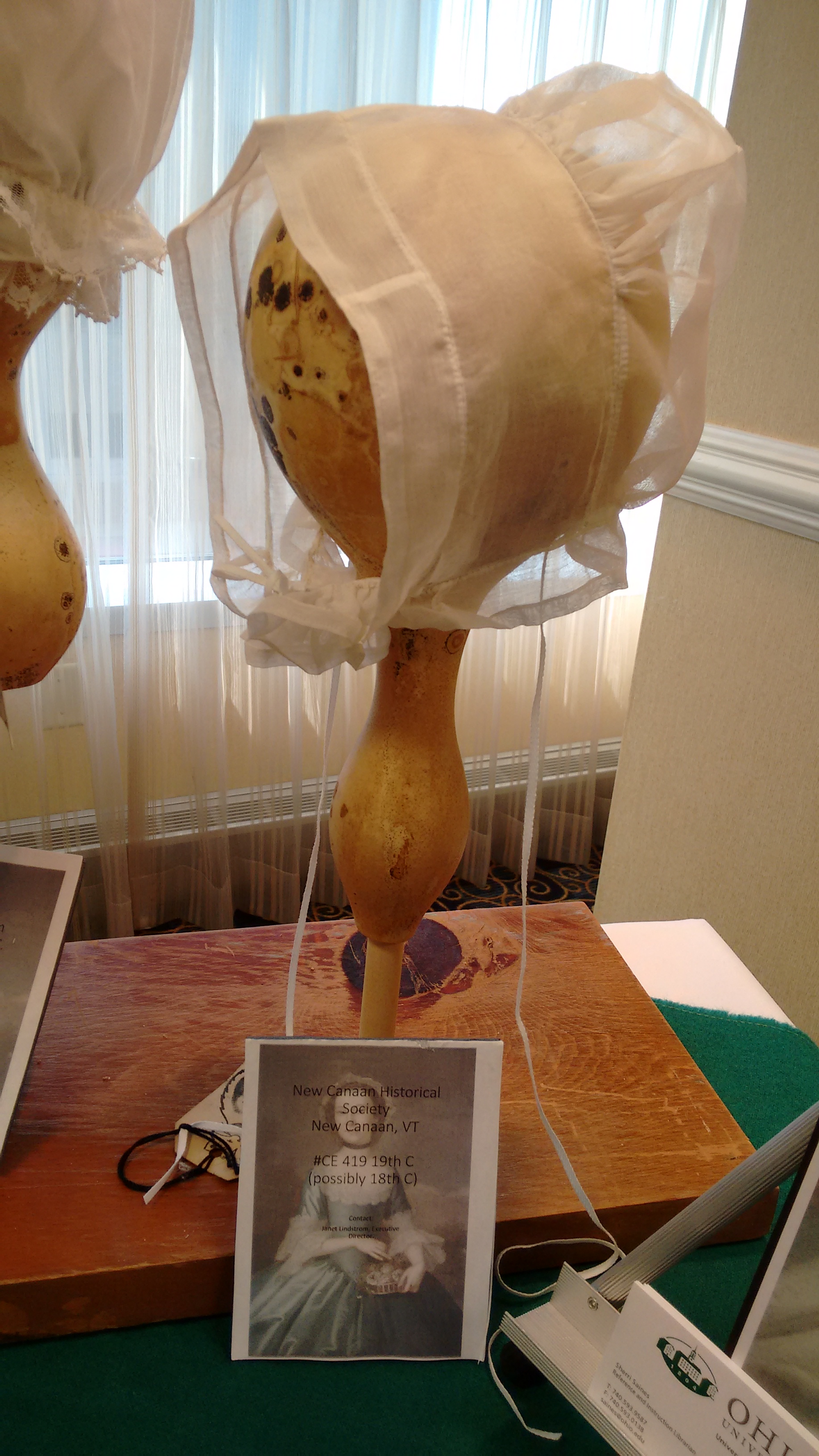
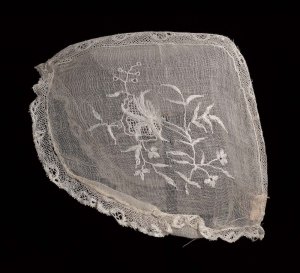
“Kissing strings” are long (40″ on this one) tapes that extend forward from the nape gather. I keep asking what people think the use was, and here are a few of the ideas:

  • wrap them back up over your head to help secure cap
  • some illogical fashion trend; some marker of age
  • made that way with the intention of cutting them shorter as per user’s head size
  • someone else can grab them and pull the wearer close — to kiss!

I haven’t seen any visible in portraits, so we’re guessing here.

This cap, from the New Canaan Historical Society in New Canaan,  Connecticut, collection, is a good example.

The Original

Lappet with many 18th C characteristics.
New Canaan Historical Society CE 419

I argue for an 18th C date because of its common 3-piece construction: caul, headpiece, ruffle. And because it doesn’t have  the characteristics of a 19th C cap.  It has one little 1/16″ pintuck 1/4″ in from the edge all down the front edge of the ruffle. Oh, and ribbons that tie the lappets. I wondered how those were done. In the portrait section, see examples of both.

The cloth is fine, probably linen, and the ruffle is even finer.  Many many mended areas on the headpiece tell us it was well loved & used.

The stitches are tiny, fine, even. Along the front ruffle edge, a 1/8″ hem finish; go in 1/4″, and there’s a 1/8″ pintuck. The ruffle is joined to headpiece with 2 1/16″ hems butted together.  The caul joined to the (hemmed) headpiece with a whipped gather. I count 25 or more of those popcorn stitches to the inch.

The lappets are 3.5″ long, and a 6″ long, 1/4″  ribbon (now shredded), handmade from a piece of silk, ties the ends.

The group of caps in their collection were donated by Deborah Bead. We corresponded briefly, and she said she did her best to date the caps, using reference sources like Cunnington’s Dictionary of Fashion History 
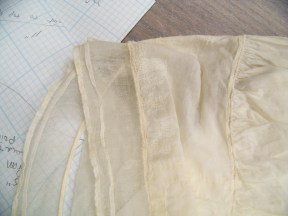
CF of cap showing ruffle and headpiece details.
The pintuck on the ruffle, and many mendings are visible here. Get a close look at those whipped gathers on the CF of the caul. New Canaan CE419
Lappet cap ends with strings.
Gathers at the ends of the lappets are fine, just enough to get around the turn. You can see the ruffles are finer than the headpiece.
Tattered ribbons still hanging on.
The ribbon ties are in bad shape. New Canaan CE 419

Questions that remain

Mended areas are always interesting, and this cap has a lot.  One possibility is some conservator did them, of course; the other is someone who loved this cap wanted to keep using it.  Did people wear mended caps?  I can see fixing a little hole or tear, but this is a lot of visible mending. Does that mean the owner was poor?  So much we can’t know.

Portraits

The difference here is lace ruffles are gathered more than the artifact we are seeing.
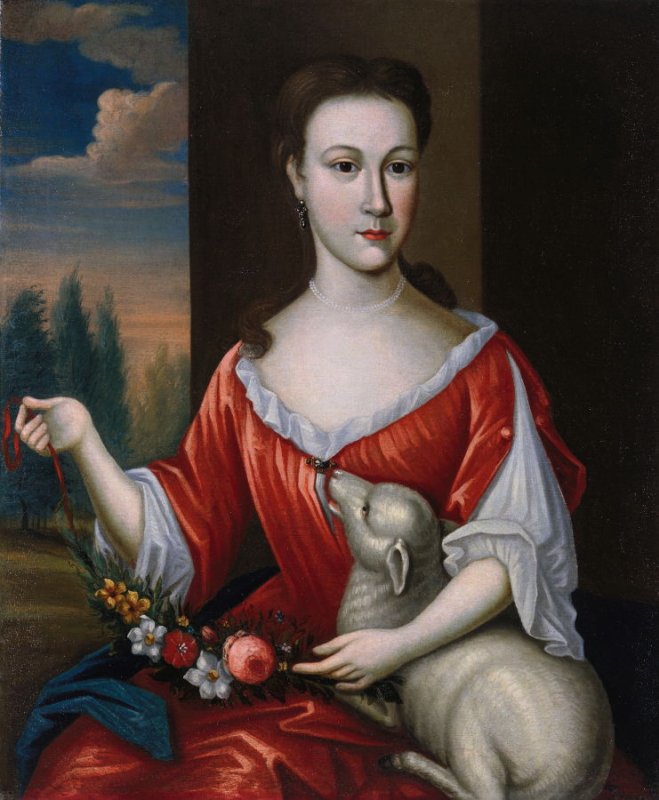
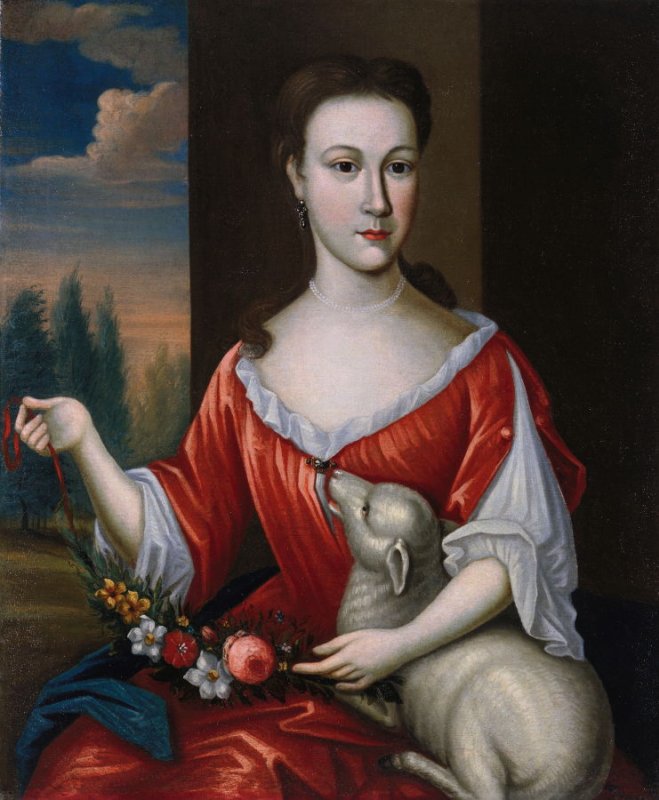
She has ribbon ties on her lappets! Creator: John Wollaston, American, fl. 1733-1775; Title: Portrait of Mrs. Ebenezer Pemberton. Artstor IAP

Mrs. Pemberton wears a cap with ribbon ties.  Her ruffles are gathered all the way down the lappets, whereas on CE419, the only gather is at the tip of the lappet, to get around the curve.

More like…  Mary Trussler, 1760.
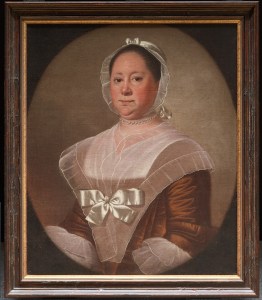
portrait of Mrs. Trusler in brown dress with large bow, and simple lappet.
Mary Trussler’s cap has very little gathering down the front of the ruffle.

Her cap is almost straight down the sides, like this one. Her ruffle appears to have a little pintuck in it.  18th C portraits can have such incredible detail in them.  The painting of transparent cloth is such a wonder to me

The Reproduction
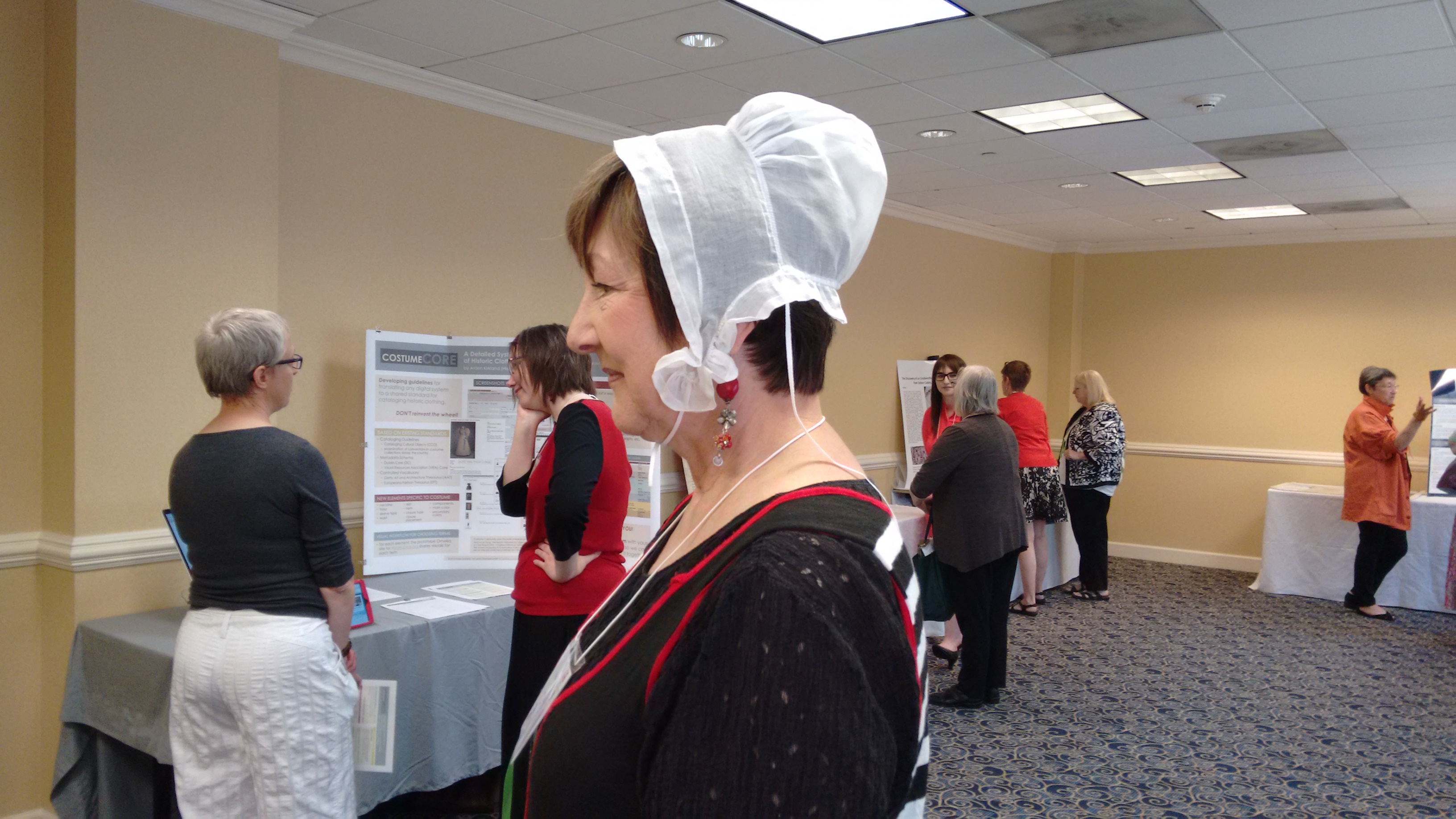
CE 419 modeled, shows how small this cap is.
A member of the Costume Society of America tried on New Canaan CE 419 for size at my exhibit there in 2016.
Saines' repro of this cap on a stand.
Once tucked under the chin, you can see how the over-gathering of the ruffle at the point creates a problem.

I think this was the first time I tried to do gathers around a lappet, and my effort is pretty comical.  No, there aren’t supposed to be those little puffs at her cheek.

Mimicking the tiny tiny stitches made this a fun challenge.  I used cotton organdy to mimic the fineness of the original cloth, and cotton mull for the ruffle.

Making a reproduction gives us a chance to TRY ON a cap and see how it would sit on a real head.  It allows us to touch and question the original design.  The artifact is so delicate it could not even be mounted, but now, despite my learner’s mistakes, we can try out the strings and see if they work tied up.  (We thought it was possible, but not really practical.)

Notes and Pattern

Click here for notes and pattern: New Can CE 419 notes

Thank Yous and Permissions

Photos by the author.  Permission to use these photos granted by NCHS 2018, via Penny Havard, Curator of Textiles. Thanks to Janet Lindstrom, who was curator at the time of my visit. Thanks to my model from the CSA.

Other Related Scholarship

New Canaan does not have an online catalog of their items.

I am not aware of any other scholarship about this item.

Final.
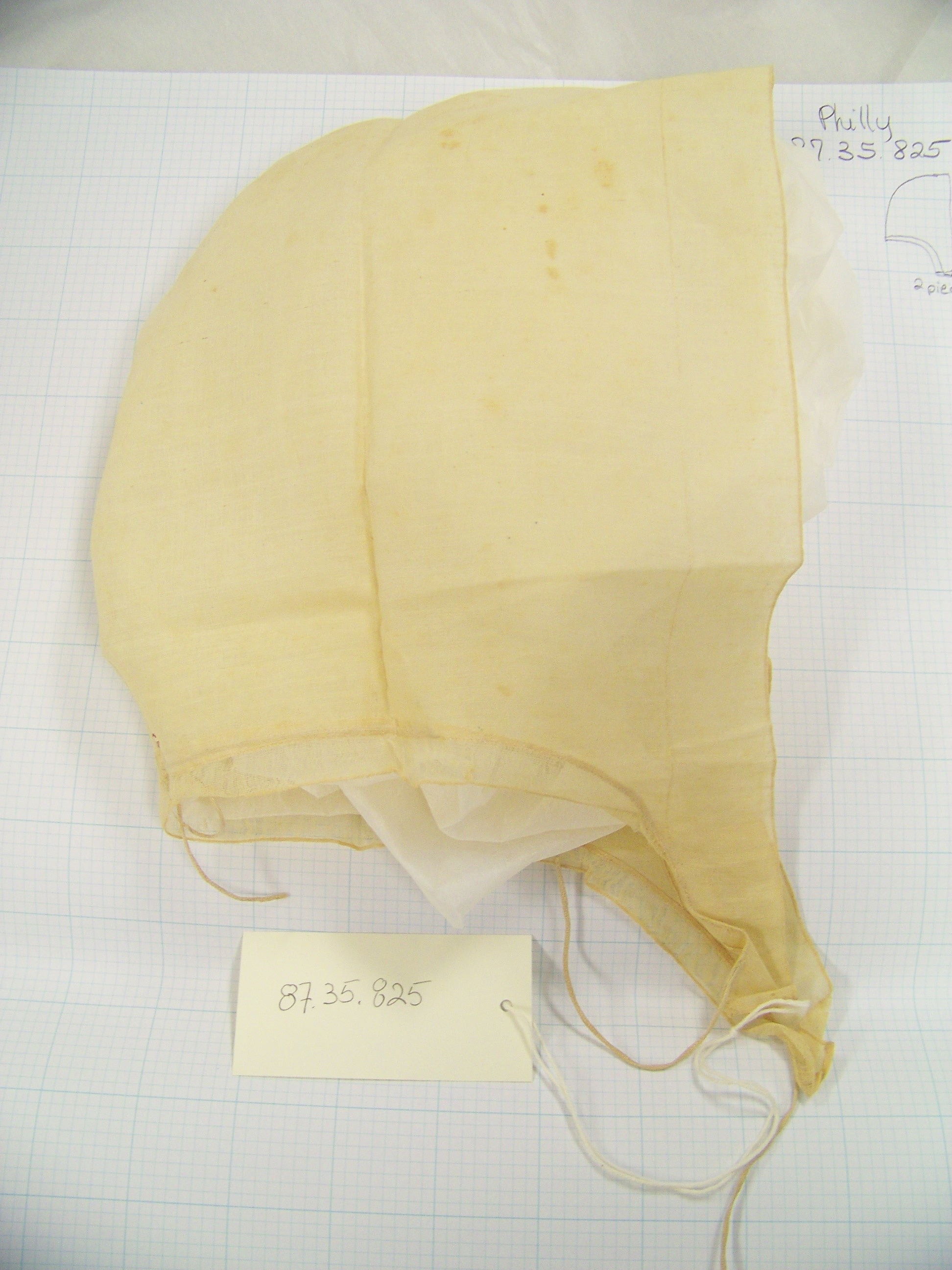
Under Ruffle? Philly 87.35.825

A Quaker with a taste for simple elegance created this cap, probably between 1750-1800.

Philly 87.35.825 is a Quaker cap, which has its own set of interpretive problems.
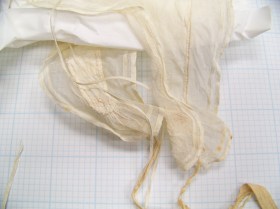
This 2-piece cap has an unusual gauzy under-ruffle that skims the nape of the neck.

Philadelphia History Museum records associate this cap with Rebecca Jones, a Quaker “minister” (their quotes, not mine), who lived from 1739-1818.  It’s a 2-piece lappet, with one unusual skinny ruffle sewn along the bottom of the cap, encircling the nape of her neck.  

The Original

The pattern for this cap is very simple: cut out 2 flat piece of super fine linen, and sew them together up the middle.  But first, whip the edges, then butt them together and whip again, with the resulting join measuring less than 1/8″ across.  This is another example of fine and exact stitching.

The front edge is rolled, not whipped, to a minute, neat, finish. The gathering channel is only about 6″ long, along the nape.  The short string comes out at the back, inside, through a buttonholed opening.  After the channel, the edge smooths down to a 1/16″ hem that finishes the back of the lappet.

A gauzy ungathered ruffle only 3/8″ wide decorates the bottom edges, from the tip of one lappet, around the nape, to the tip of the other.  Its edges are also minutely hemmed, then whipped to the cap.

The other decoration is a row of tiny straight stitches 1″ back from the front edge of the cap, completely straight and even, giving the impression of being pieced, or maybe she just liked the sheen of the thread. I’ve seen this detail on numerous Quaker caps.

I think this is the only cap I’ve seen with a laundry marker.  It is a red “G” in itty bitty cross stitches.  I wonder why  Rebecca Jones made a cap marked “G”?  I guess a cap “associated with” Rebecca doesn’t necessarily mean it was “hers.”  Did she make it for a daughter — Gertrude or Gina?

Questions that remain

One detail makes me wonder about the pre-1800 date: the squared lappets.  Curators at both Philly and Chester County were willing to say that is characteristic of post-1800 caps.  

Portraits

Cap with simple, wrapping lappets, but the caul is high and gathered.
Mrs. Cooke, by William Jennys (fl. 1790 to 1810) – Honolulu Academy of Arts, Public Domain, Mrs. Cooke’s cap has some attributes of our example, but isn’t s close match.

The front of Mrs. Cooke’s cap looks similar to this one, a simple lappet with no ruffles.  The Philly example has ties at the tips, but in this portrait I think she has overlapped the ends and pinned them.  I do think this one is made in 3 pieces, so it has shape and gathers that this cap doesn’t have. I can’t find a portrait of a cap that seems to be made of only 2 flat pieces.  Can you find one?

The Reproduction

The pattern was easy because the cap lies almost completely flat.  The only question I had was whether to dip in the nape or cut it straight and let the gather string make that curve. I opted to cut in the curve.

The one-piece lappet has a small ruffle along on the bottom.
Saines repro of Philly 87.35.825.

I had a problem with this one that I’ve had with others: when I whip an edge, then whip the whipped edged together, I end up with dinosaur humps. See how it makes a Stegosaurus back? That join is stiff and inflexible, too.  Someone suggested it was because I was stretching the cloth as I worked, and to run a line of stitching up the edge before whipping it. I’ll try that next time.

I also forgot the strings at the ends.

I think this cap has an especial simple beauty.  It’s unique and intriguing and elegant.

My Notes

Click here for notes and pattern:  philly 87.35.825

Thank Yous and Permissions

Kristen Froehlich, Director of the Collection and Exhibits at the Philadelphia history Museum at the Atwater Kent gave me permission to use images I made and discuss this artifact here.

Other Related Scholarship

This cap does not appear in the museum’s online catalog.

I am not aware of any other scholarship on this cap.

Final.
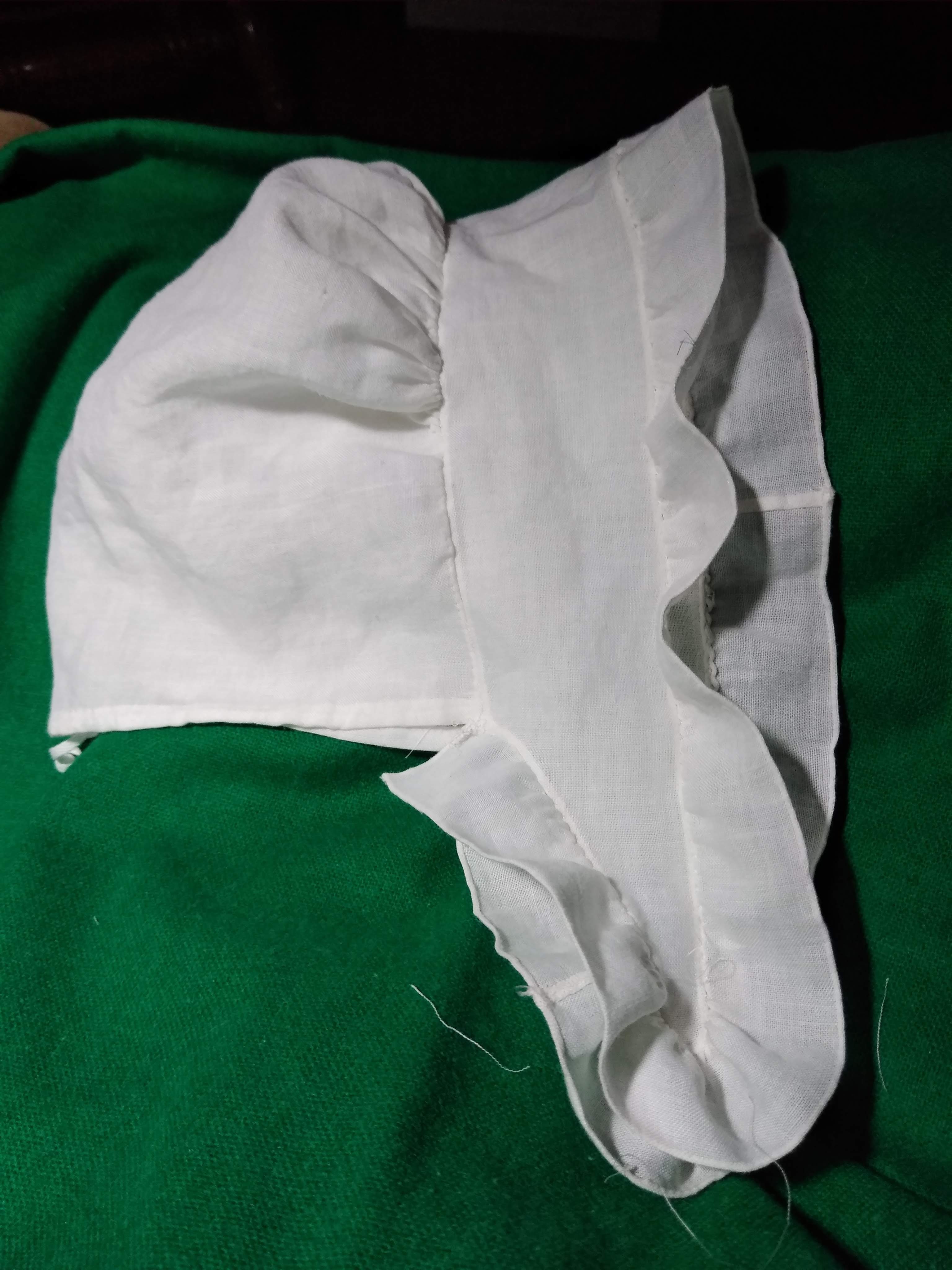
Thick Linen Warmth: Philly 1973.37

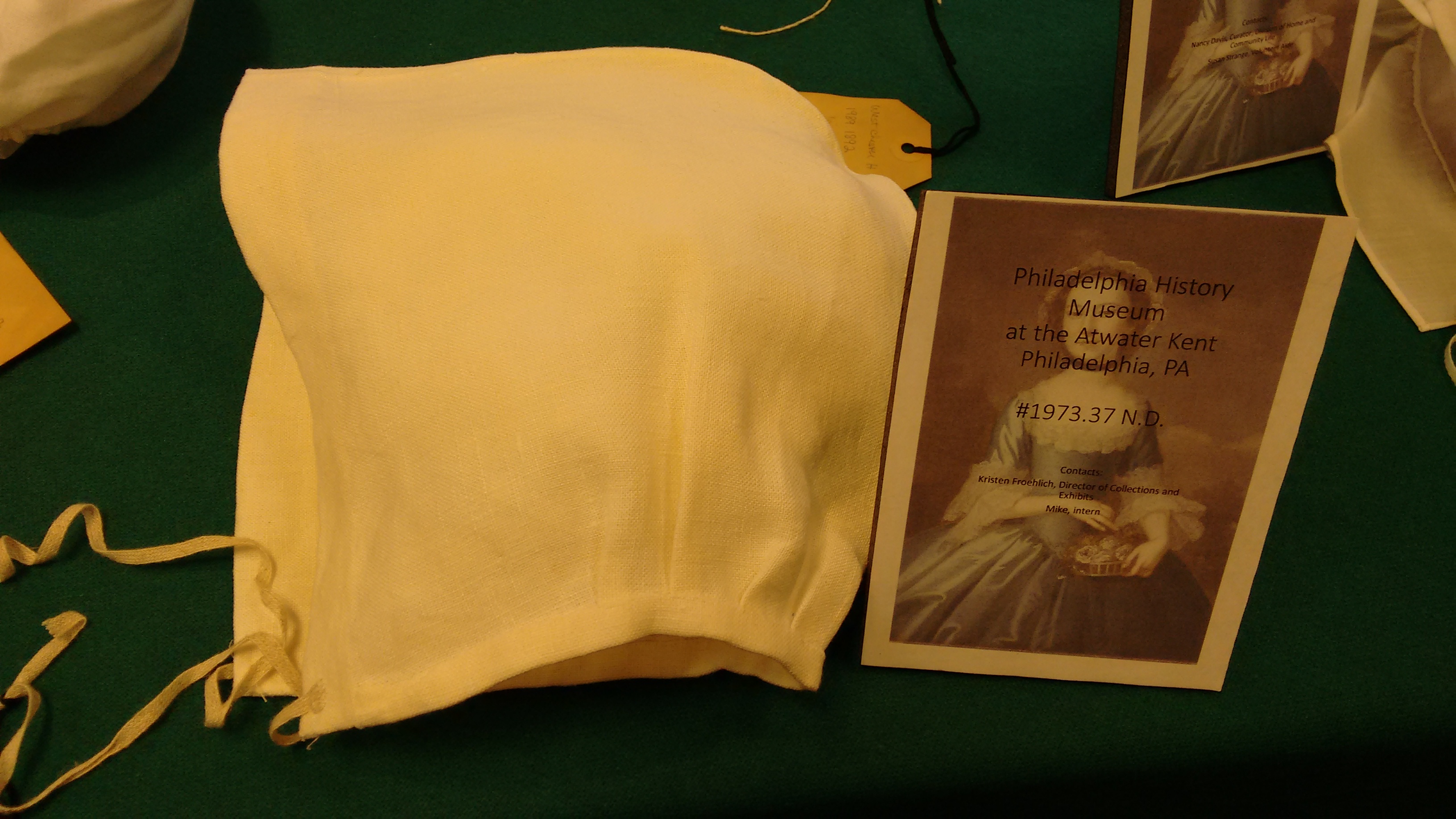
A cap for warmth? A cap to sleep in?  An undercap or should we call this a hood? The Philadelphia History Museum doesn’t date this cap, and nothing elsewhere is like it. I include it because it is unique, and doesn’t have any 19th C characteristics.   It could be 18th C, or of course, much later.

The Original

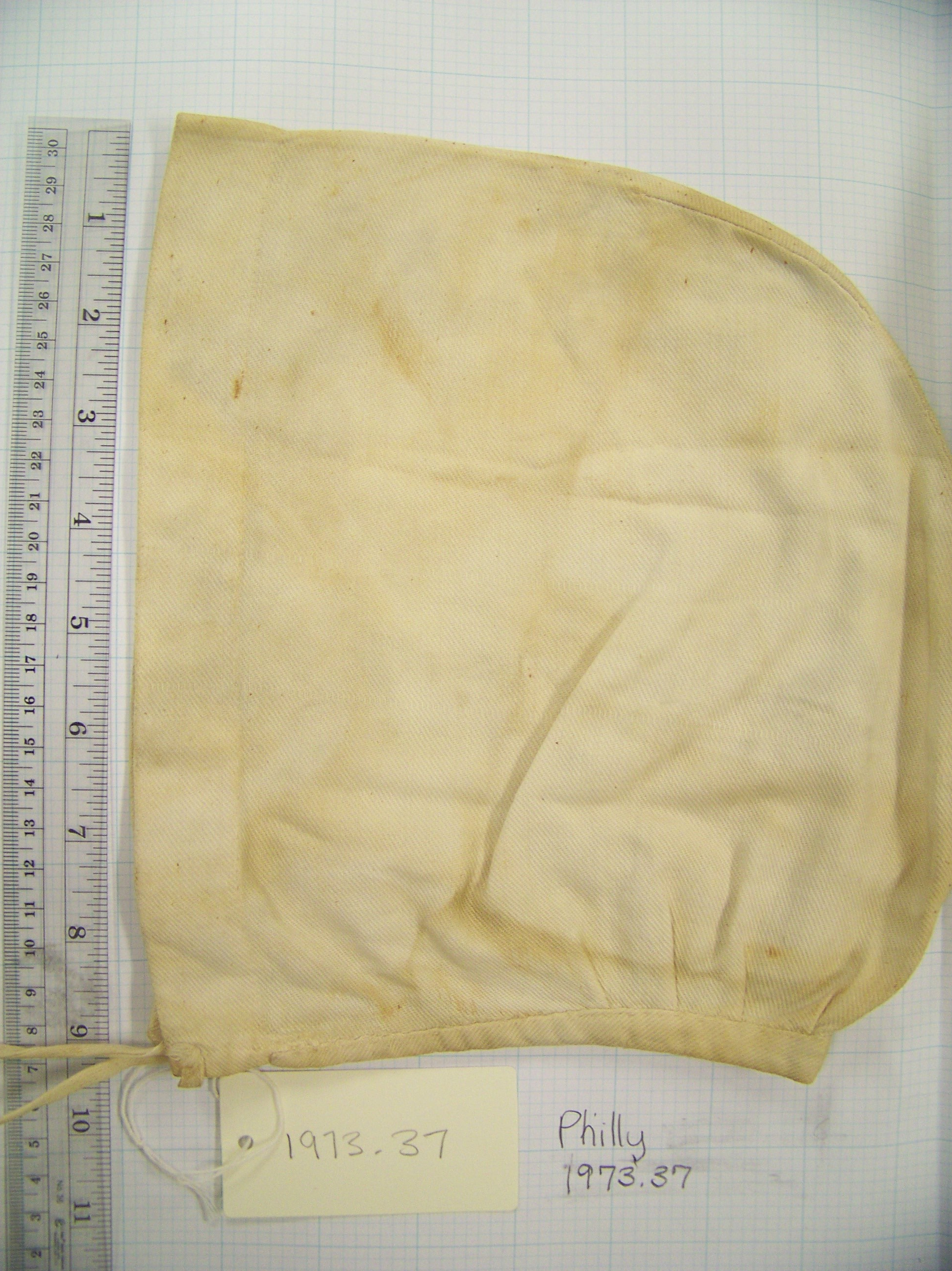
It’s a simple 2-piece cap made of very heavy linen. four pleats at the nape give it enough shape to snug one’s head. A 1″ hem along the straight front edges add heft.

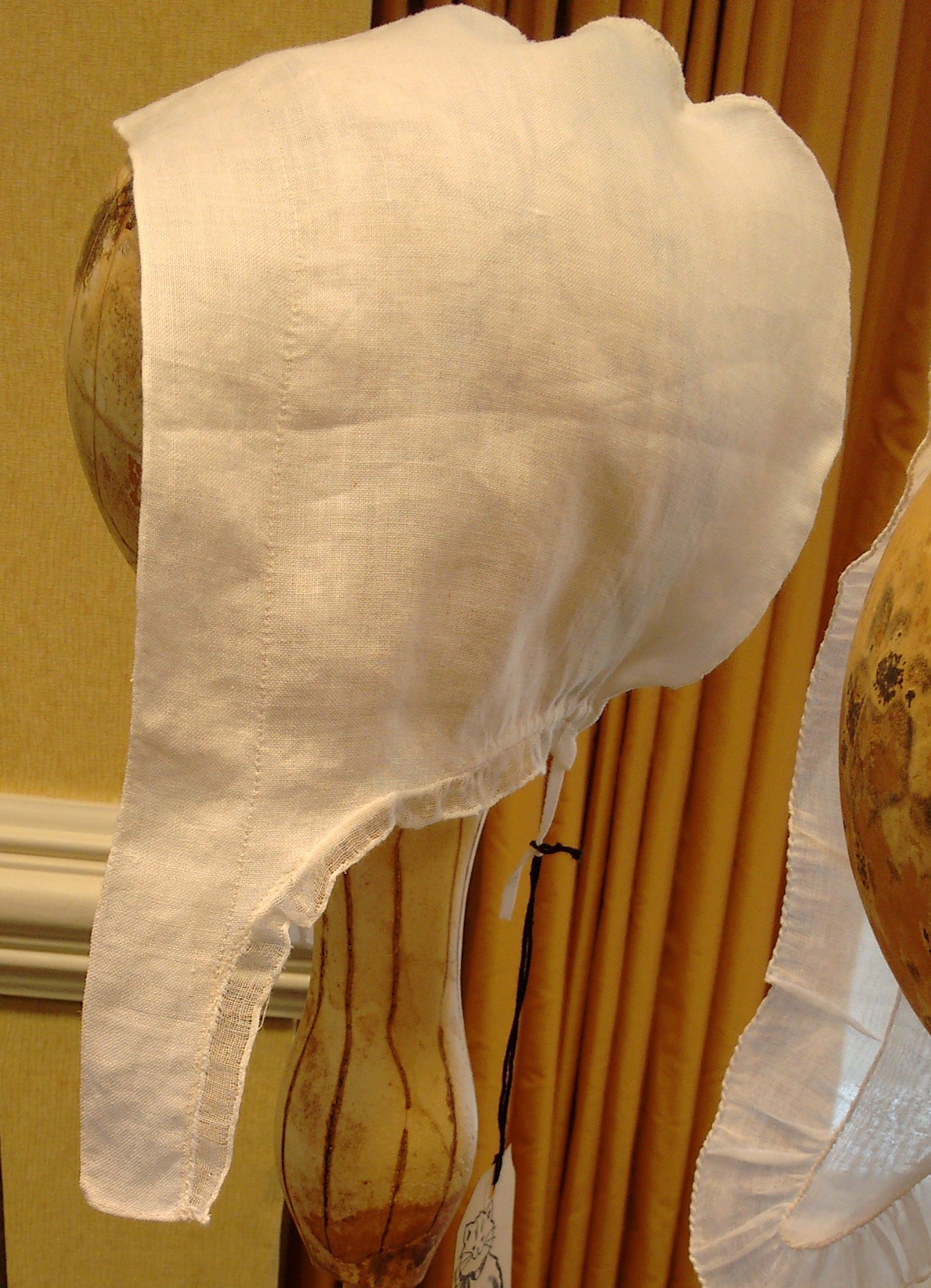
2-piece heavy linen cap, tied under the chin, pleated at the nape.
Philly 1973.37 Warm Linen cap

Plain linen tapes tie it under the chin.  The edges are finished by wrapping a linen piece over the edge and sewing it down inside and out.

The two main pieces are almost square, with just one corner rounded off, which becomes the curve in the shape at the top back. These are joined with a felled seam.

The original is stained and spotted, and one of the halves is pieced about 2″ up from the bottom edge.

The museum doesn’t give it a date, as I said, but this is a part of the Friends Historical Association Collection, which is made up of items

“used or owned by members of the Religious Society of Friends who lived within the boundaries of the Philadelphia Yearly Meeting from the mid-18th century to about 1925.”

It was with a group of caps, hoods (oh, those silk hoods!), and bonnets, some of which have 18th C dates.

Questions that remain

You think you have measured and examined every possible angle of an item, and then a question arises that you still can’t answer. I couldn’t determine from my notes whether that string was a gather string that went through the bound bottom edge, or just a tape sewn on the outside.  I decided it was a tape sewn on the outside.  What do you think?

Portraits

I have not found any American portraits with a cap or hood like this. I’m still looking, of course.  I’m reminded of the Chocolate Girl’s colored cap cover (French, 1743).  Some baby caps fit snug to the head like this, made more commonly in three pieces than two.  But this is an adult size cap for sure. It fits my head, and I have a big head.

Fine embroidered infant cap from Boston MFA, made of 2 pieces.
Boston MFA 37.457 Infant cap in 2 pieces, 18th C.

The Boston MFA, for example, has a 2-piece infant cap (dimensions 16.2 x 15.5 cm (6 3/8 x 6 1/8 in.).

The Reproduction

I made this cap of a heavy linen, very similar to the original’s thick slubby cloth.  I had never had to figure out pleats from scratch before, so that was a challenge. four little pleats on each side was maybe a good introduction to the world of  measured folds.

I like this cap for its practical uses. it really is warm and stays on when sleeping.  Field-tested HA headwear.

Saines' reproduction of simple 2-piece linen cap with linen tapes under the chin.
My repro of Phill 1973.37. This is one time when I could closely replicate the cloth.

My Notes

Click here for notes and pattern: my notes: philly 1973.37

I sort of patterned this while I looked at it, so the pattern and notes are one thing.

Thank Yous and Permissions.

Kristen Froehlich, Director of the Collection and Exhibits at the Philadelphia history Museum at the Atwater Kent gave me permission to use images I made and discuss this artifact here.

Other Related Scholarship

I am not aware of any related scholarship for this cap. It does not have an online catalog record.

Final.

DAR 1203: A Cap With A Story

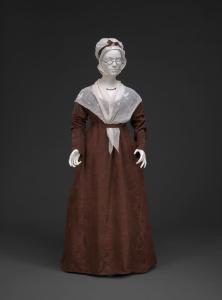
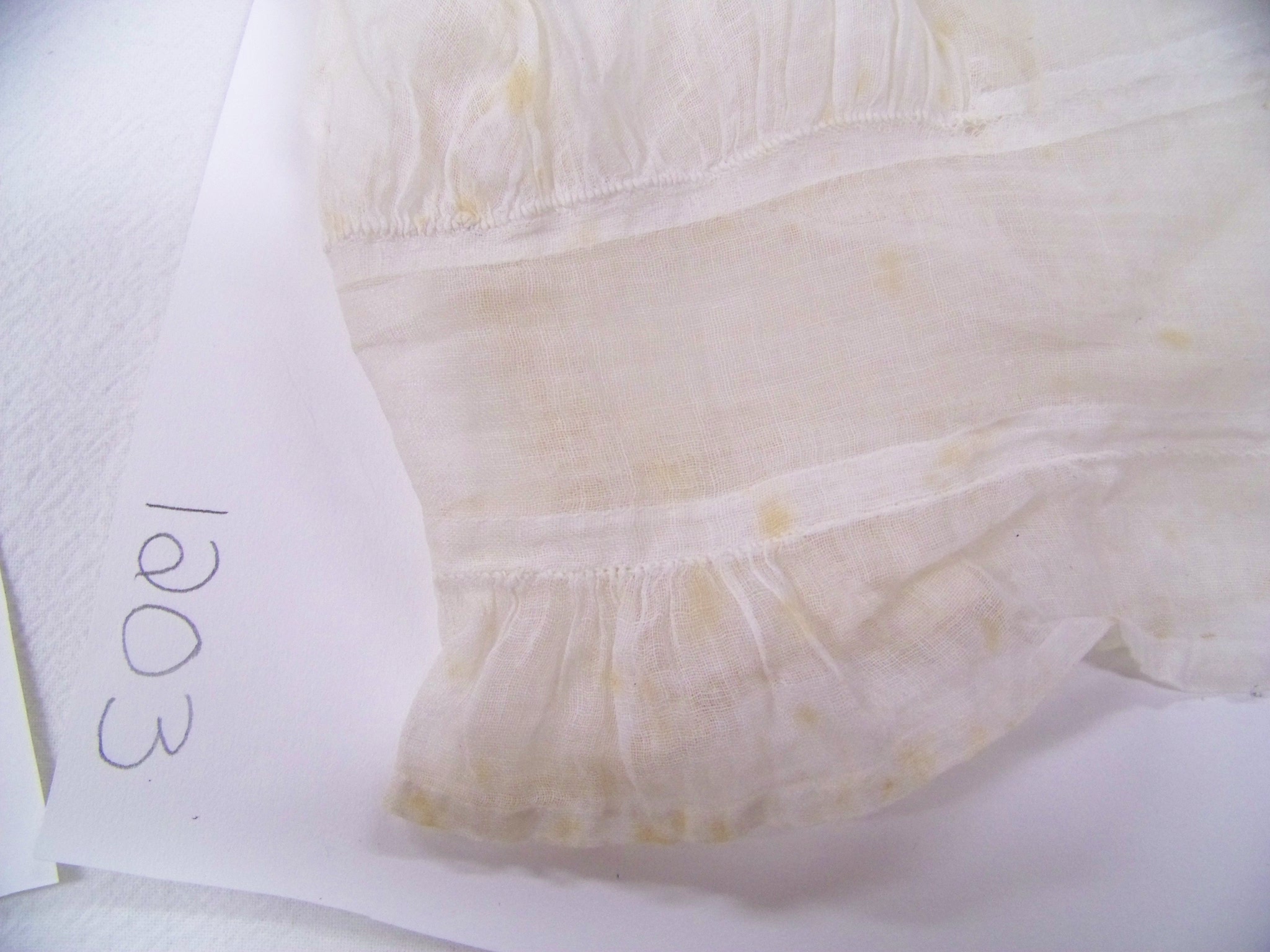
Few caps are actually dated, but this one has a story and a date.  It’s a simple lappet cap, small and unadorned, of soft sheer cotton mull.  The catalog record tells the story:

“Janneke Phoenix Krum was the wife of Hendrck W. Krum — a soldier of the American Revolution. The flax was spun and woven by Janneke Krum, and the cap made by hand — also by her.”

They were married on May 4, 1777, so the record implies this is her wedding cap.  The DAR Museum in Washington, D.C. owns this cap.

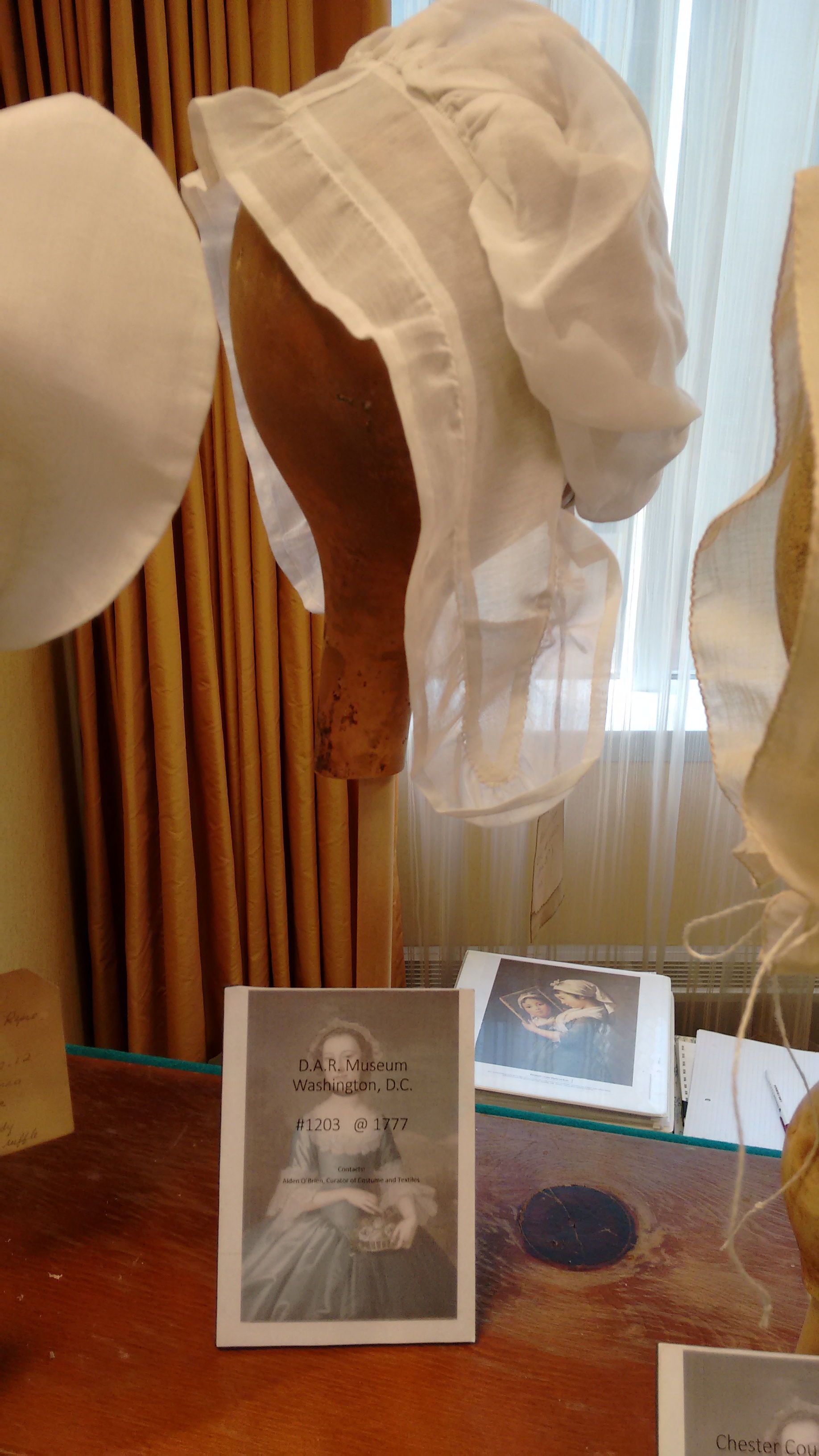
A lappet cap displayed with a red empire dress and white neckcloth.
The cap on this dress model is DAR 1203, a simple lappet with a story.

The Original

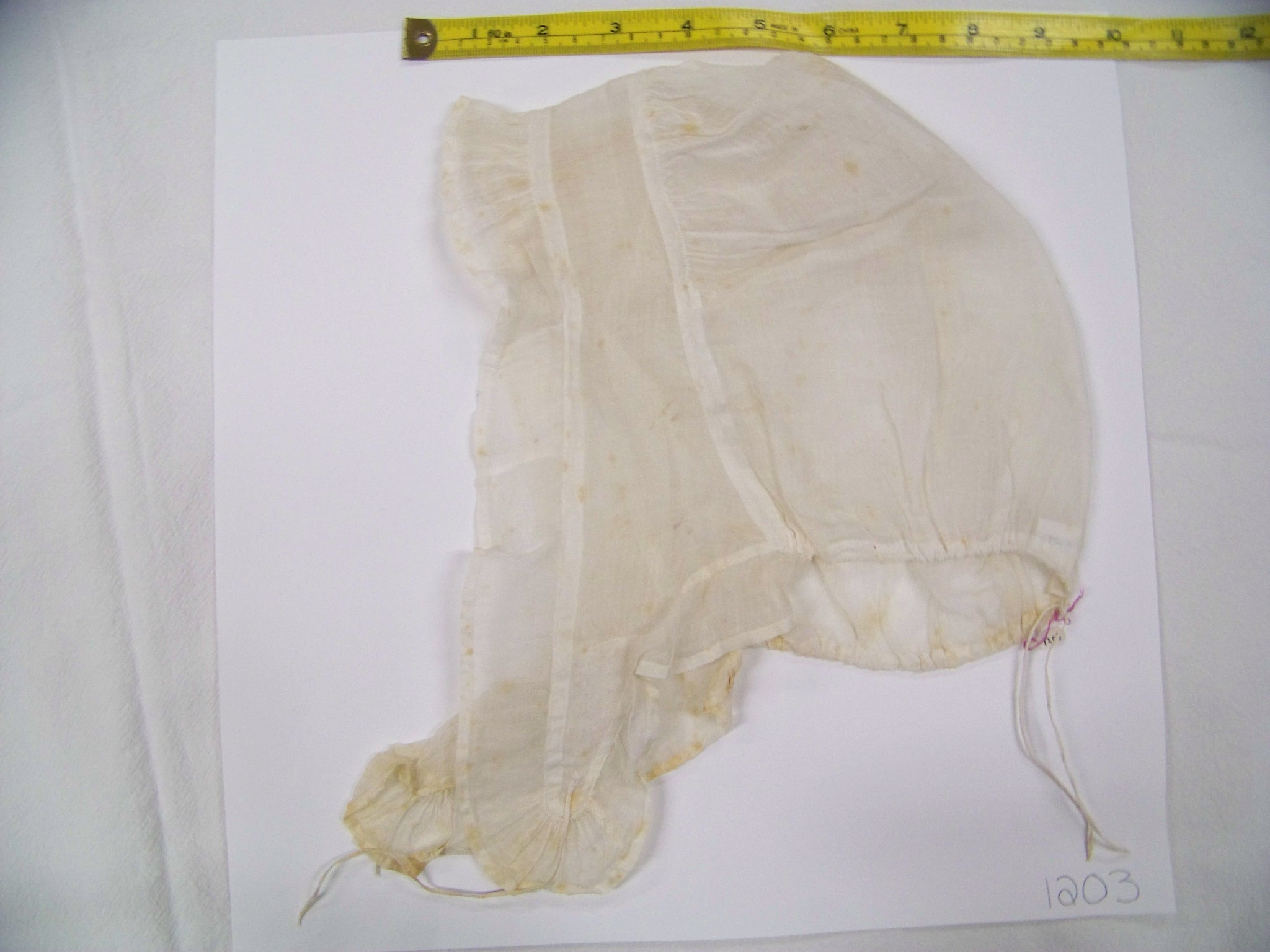
Made of three pieces, caul, headpiece, and ruffle, but with wide (1/4″) hems throughout.  The caul is gathered to the headpiece with whipped gathers over the top 6″ of the headpiece.  The headpiece is on the straight grain, 1.5″ at the CF, widening to 3 1/4″ where the caul and headpiece meet under the ears, and skinnying down to 1/2″ wide at the ends. The ruffle is joined to the headpiece with a whip stitch.

The ruffle is gathered at the CF and at the turn of the lappet only, a common characteristic of the era.  The headpiece is reinforced with tiny triangles of cloth at the tips to withstand the tension of the gathering strings attached there.

Close-up of center front ruffle, top of headpiece, tight gathering of the caul.
The gathered CF ruffle of DAR 1203.
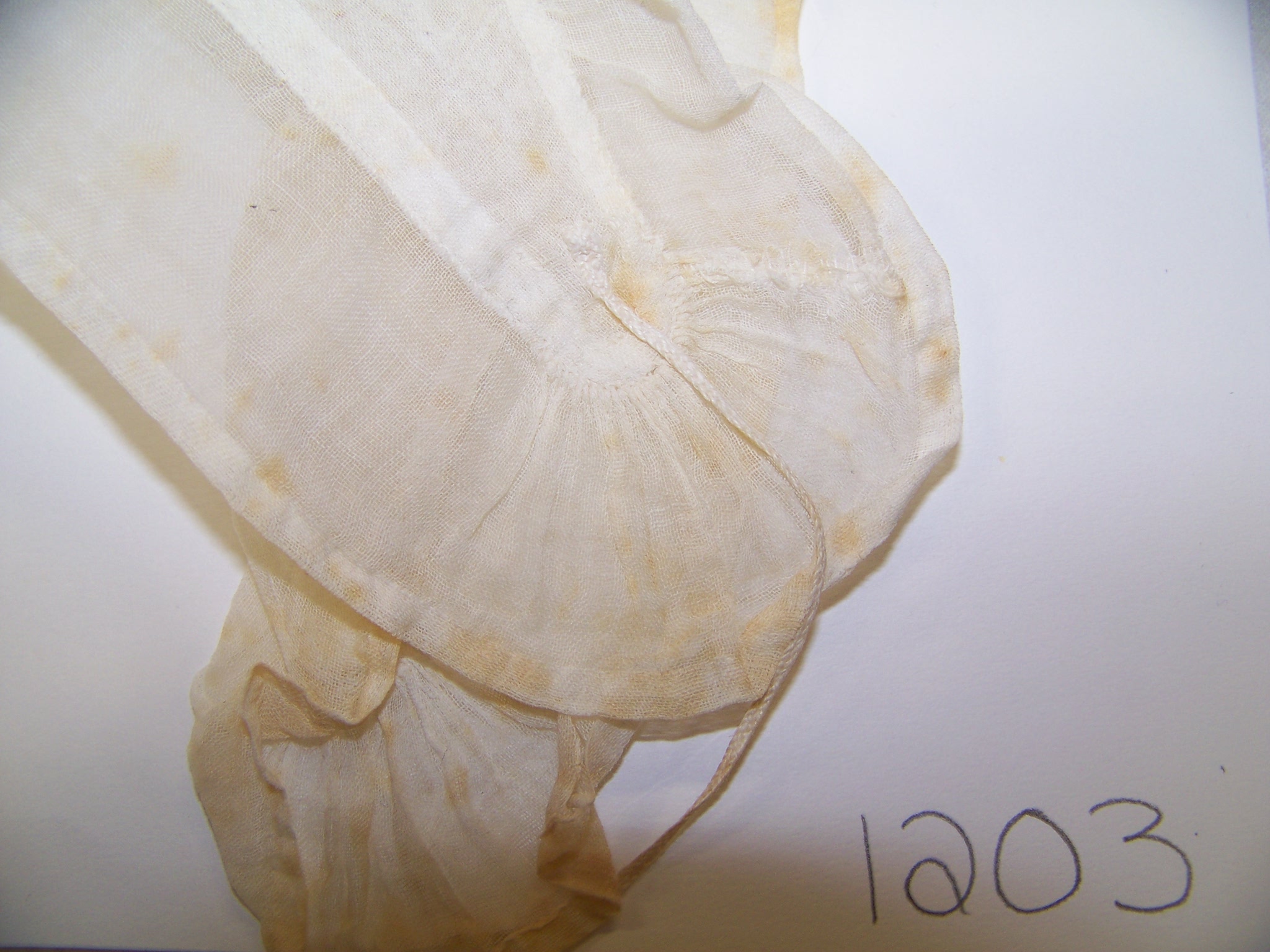
Close up of the end of the lappet of DAR 1203, showing gather of ruffle and string ties.
Gathers go gently around the lappet, and a string attached here ties the ends under one’s chin.
Cap #1203 from DAR Museum is a lappet with wide hems throughout.
The 1/4″ hem throughout might be an indicator of a later date?

 Questions that Remain

The wide hems and the cotton cloth make me wonder if this is 19th C, but the style and construction fit the bill for 18th C.  Note the museum record says Mrs. Krum spun the flax (i.e., linen) herself, but then identifies the cloth as cotton mull.  I wonder if this is a cap from later in her life?  I wonder if the hand-spun cloth story is real.

Portraits

Portrait of woman wearing lappet cap. John Wollaston, Portrait of Mrs. Ebenezer Pemberton, ca. 1750. RISD Museum.
This cap is similar, with a special extra gather at the top in the front.

Lappet caps are the most common mid-century cap.    Notice that she has a ribbon under her chin. DAR 1203 has a surviving tie sewn on to the tips, to tie under the chin. I wonder if the ribbon in this portrait is sewn on to the cap, pinned on, or tied around her neck separately?  I’d opt for sewn on to the cap, but I’ve never seen ribbons on an original, not until the 19th C when they grow large and wide.

The Reproduction

I’m still learning about how the weight of the cloth impacts the gather.  On this cap, although the whipped gather only goes across the top 6″ of the cap, I had to keep gathering it nearly all the way down the sides to make the caul fit onto the headpiece.  That’s also partly because I was still learning how to infer a flat pattern from gathered shape, and got the proportions wrong. Another complicating factor was replicating that curve under the ear.  Most caps are straight here.

Saines' reproduction on DAR 1203, lappet cap of cotton, shown on hat display.
My version of DAR 1203.

My Notes

Click here for notes and pattern: BookScanCenter (1)

You can see the problems I had making a pattern!  I’ve gotten better at this over time.

Thank Yous and Permissions.

Thanks to Alden O’Brien, Curator of Costumes and Textiles, of the Daughters of the American Revolution Museum in Washington, DC, who gave me permission to blog about the DAR caps I saw.

Other Related Scholarship

I am not aware of any scholarship on this cap.

Final.

This is the Template for Artifact Posts: Give it a descriptive name and include the accession no. here.

Describe what makes this cap interesting. Using the accession no., identify the general style, and components. Link out to museum record, or museum.

this is a picture.
This is so interesting! you won’t believe it.

The Original (use heading 3 thruout)

Go on to describe how it is constructed: stitches, pattern pieces, cloth.

Any notes the museum has about provenance or other details. Museum date; my date, and why. Give details from my notes. What did I see?

Aenean at pulvinar nibh, ut convallis nisi. Quisque quam libero, iaculis blandit fringilla non, dignissim sed sapien. Cras rhoncus et purus eu scelerisque. In id arcu ligula. Sed a diam vel mauris molestie efficitur sit amet et tortor. Duis elit lectus, lacinia sed leo non, tincidunt iaculis diam. Phasellus placerat magna nec nisl vehicula efficitur. Quisque eget nibh ullamcorper, ultricies ante ut, imperdiet nulla. Nunc sollicitudin, lacus et auctor rhoncus, magna velit elementum arcu, ut posuere magna eros vitae mi. Vestibulum pellentesque massa a tincidunt tempus. Nunc non erat eros. Curabitur porta turpis non nisl tincidunt scelerisque. Quisque malesuada placerat vestibulum. Maecenas egestas aliquam ante, in viverra diam faucibus at.


These 3 are part of a Gallery.  it isn’t helpful. Possibly a montage of details. Caption with why each photo is here.

for each photo, link to media file or URL, size it, click “open in new tab”

Questions that remain

What don’t I understand?  Aliquam non nisi ut odio gravida dapibus. Sed in elit at mauris tempus ultricies. Fusce vestibulum, diam in finibus finibus, turpis orci dictum tortor, tempor feugiat nisi mi in lorem. Vivamus egestas, ligula eu mollis bibendum, elit massa iaculis nisl, at sollicitudin nulla ante nec purus. Nulla blandit risus non efficitur euismod. Cras cursus i

Portraits

Add a period portrait here with a similar cap.  Use Artstor (see my collection there), or MOMA, or other museum-linked images. Add to my WP gallery, and link out from there. Careful about copyright. Talk about how common this one is.

1749-52 John Wollaston (American colonial era painter, 1710-1775) Catherine Harris Smith (Mrs. Ebenezer Pemberton) Artstor IAP.

Lorem ipsum dolor sit amet, consectetur adipiscing elit. Mauris sit amet ipsum sapien. Aliquam efficitur at tortor ut facilisis. Praesent eu accumsan tellus. Fusce pulvinar, lorem ac porttitor sodales, lorem nibh finibus velit, nec gravida felis nulla in sapien. Integer faucibus sapien in luctus consequat. Suspendisse ut turpis ligula. Lorem ipsum dolor sit amet, consectetur adipiscing elit. Mauris sit amet ipsum sapien. Aliquam efficitur at tortor ut facilisis. Praesent eu accumsan tellus. Fusce pulvinar, lorem ac porttitor sodales, lorem nibh finibus velit, nec gravida felis nulla in sapien. Integer faucibus sapien in luctus consequat. Suspendisse ut turpis ligula.Lorem ipsum dolor sit amet, consectetur adipiscing elit. Mauris sit amet ipsum sapien. Aliquam efficitur at tortor ut facilisis. Praesent eu accumsan tellus. Fusce pulvinar, lorem ac porttitor sodales, lorem nibh finibus velit, nec gravida felis nulla in sapien. Integer faucibus sapien in luctus consequat. Suspendisse ut turpis ligula. nteger faucibus sapien in luctus consequat. Suspendisse ut turpis ligula.Lorem ipsum dolor sit amet, consectetur adipiscing elit. Mauris sit amet ipsum sapien. Aliquam efficitur at tortor ut facilisis. Praesent eu accumsan tellus. Fusce pulvinar, lorem ac porttitor sodales, lorem nibh finibus velit, nec gravida felis nulla in sapien. Integer faucibus sapien in luctus consequat. Suspendisse ut turpis ligula.

The Reproduction

My Reproduction: problems I encountered. What I learned by making this.

depth of field photography of woman in pastel color sleeveless shirt and white sunhat
This is my reproduction. Note this detail. Include attribution, alt text, description.

I have a whole lot to say here.

In nec auctor dolor. Integer rhoncus blandit lectus sed auctor. Aenean non libero diam. Morbi iaculis dolor arcu, quis sollicitudin dolor egestas vitae. Sed ornare, erat nec auctor auctor, nisi tellus dignissim risus, sit amet dictum nisl eros id erat.  In nec auctor dolor. Integer rhoncus blandit lectus sed auctor. Aenean non libero diam. Morbi iaculis dolor arcu, quis sollicitudin dolor egestas vitae. Sed ornare, erat nec auctor auctor, nisi tellus dignissim risus, sit amet dictum nisl eros id erat. In nec auctor dolor. Integer rhoncus blandit lectus sed auctor. Aenean non libero diam. Morbi iaculis dolor arcu, quis sollicitudin dolor egestas vitae. Sed ornare, erat nec auctor auctor, nisi tellus dignissim risus, sit amet dictum nisl eros id erat.

My Notes

Click here for notes and pattern: [link]

Duis at vestibulum lacus. Nam sit amet laoreet risus, eget aliquet metus. Mauris nec massa sed nibh sodales luctus. Vivamus eu eros ornare, ullamcorper nulla quis, viverra turpis. Proin euismod neque nunc, quis volutpat dui fermentum sagittis. Integer aliquam diam quis quam pretium mollis. Mauris sed nisi ligula.

PDFs of my notes, pattern, other

Thank Yous and Permissions

This person gave me permission to use images (mine or theirs) and discuss this artifact here. They also helped me in this way.

Photos by the author.

Other Related Scholarship

Does this cap appear in any books?  Write a citation here in APA.

Author, A. A., & Author, B. B. (Year of publication). Title of chapter. In A. A. Editor & B. B. Editor (Eds.), Title of book (pages of chapter). Location: Publisher.  (link to Amazon? Link to Google books?  World cat?)

Does this cap appear in any web pages?  Ditto. make as many links live as possible.

Author, A. A., & Author, B. B. (Date of publication). Title of document. Retrieved from http://Web address


Now go back and add categories, links to glossary, tags, links to other scholarship. 


The Odd One: DAR 2005.13

The Odd One: OK, but WHY?

The Artifact

The only extant cap so far that comes close to the huge linen piles of the late 18th C is this example in the DAR Museum in Washington, D.C.  This one is very fine muslin, with a huge caul gathered on a completely circular doubled band.  There is no way to adjust the size; it must have been made to fit.

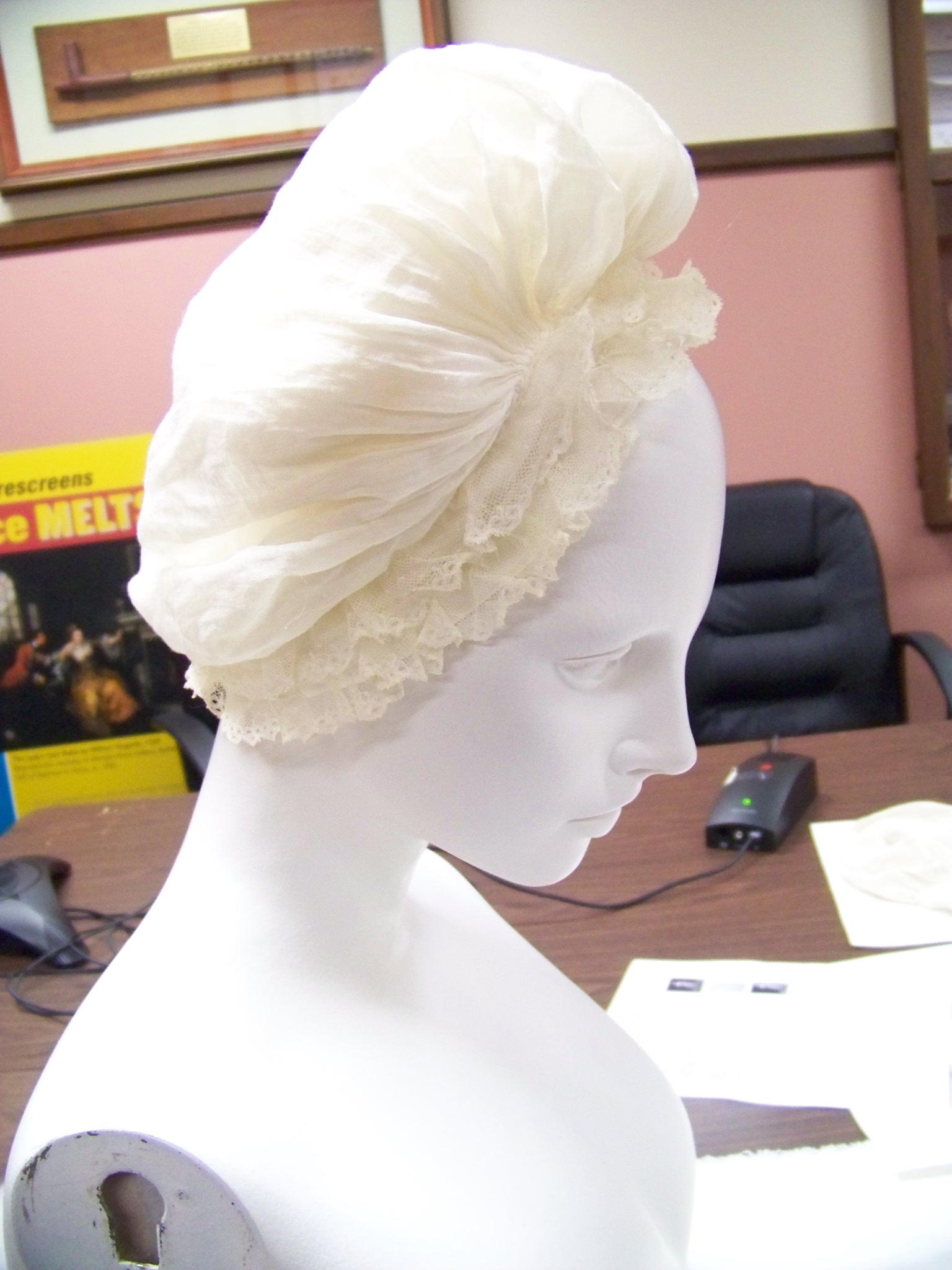
Very fine muslin cap with large caul gathered to a fixed band, ringed with lace.
DAR 2005.13 This late century style is often called a “mob cap.” I think I disagree.

Most of the caul’s gathers are at the center front (CF), on the high forehead.  The sides are not gathered, and the rest of the caul’s cloth is gathered in lightly at the nape.  All the gathers are stroke gathers, tucked into the band.

Three different laces on the band gussy up the fluff. This cap was displayed in the DAR exhibit, An Agreeable Tyrant, and in the book of the same name.

The Reproduction

A large caul is gathered into a non-adjustable headband.
My reproduced version of the DAR’s 1790’s cap.

Here is my repro:

My muslin is thicker than the original, so maybe that’s why it sticks up so much? I also don’t know much about period lace, so I just used something with the same look, and tried to figure out where to put it.  There’s a layer sewn inside the band, a layer sewn at the join of the band and the caul, and a third piece that only goes half way around sewn in between the other layers.  I assume that layer denotes the front.

The museum dates this cap 1790’s, and that fits with portrait evidence. Here is more about the portrait evidence in this post.

Questions that Remain

So far so good. But here’s what I really want to know: why don’t we have more of these? If the high crowned caps are later than the simple lappets, why do we have more extant earlier caps?  Of all the portraits showing these crazed mushroomy caps, why would only one American example survive?

Speculation: there was so much cloth and linen in each one, they could be turned into two or three other caps after they went out of style, so they were all remade.

Worry:  all the surviving caps we call 18th C are just a bunch of 19th C Quaker caps that we have misidentified.

Worrier:  This one is a reproduction made much later, for the Centennial, for ex.  The construction might argue for that, as this is the only cap I’ve seen gathered on a band with no adjustment.

Still, it’s beautiful and unique.

Portrait

1798 portrait of Mrs. Dewey with high poufed cap and laced edges.
Mrs. Dewey wears a similar cap.

In this 1798 portrait by Ralph Earl, Mrs. Elijah Dewey ( Mary Schenk) wears a cap with a very large poufy caul, with a round headpiece, and lace for ruffles.  The difference here is that the face-shadowing lace is not ON the headpiece, but added to its edges like a ruffle. Her cap includes a lace piece at the join of the caul and the headpiece, like our artifact.  but note that the lace is shaped, getting wider at the back.  That ruffle shape is associated with a cap called a Corday, after a famous female hero of the French Revolution who wore caps of that type.

Notes and Pattern

Here are my notes and the pattern I used. I had to really guess at the shape of the caul. DAR 2005.13 notes

Thank Yous

Thanks to Alden O’Brien, Curator of Costumes and Textiles, of the Daughters of the American Revolution Museum in Washington, DC, who gave me permission to blog about the DAR caps I saw.

This cap is not in their online catalog and has no provenance that I know of.

final.
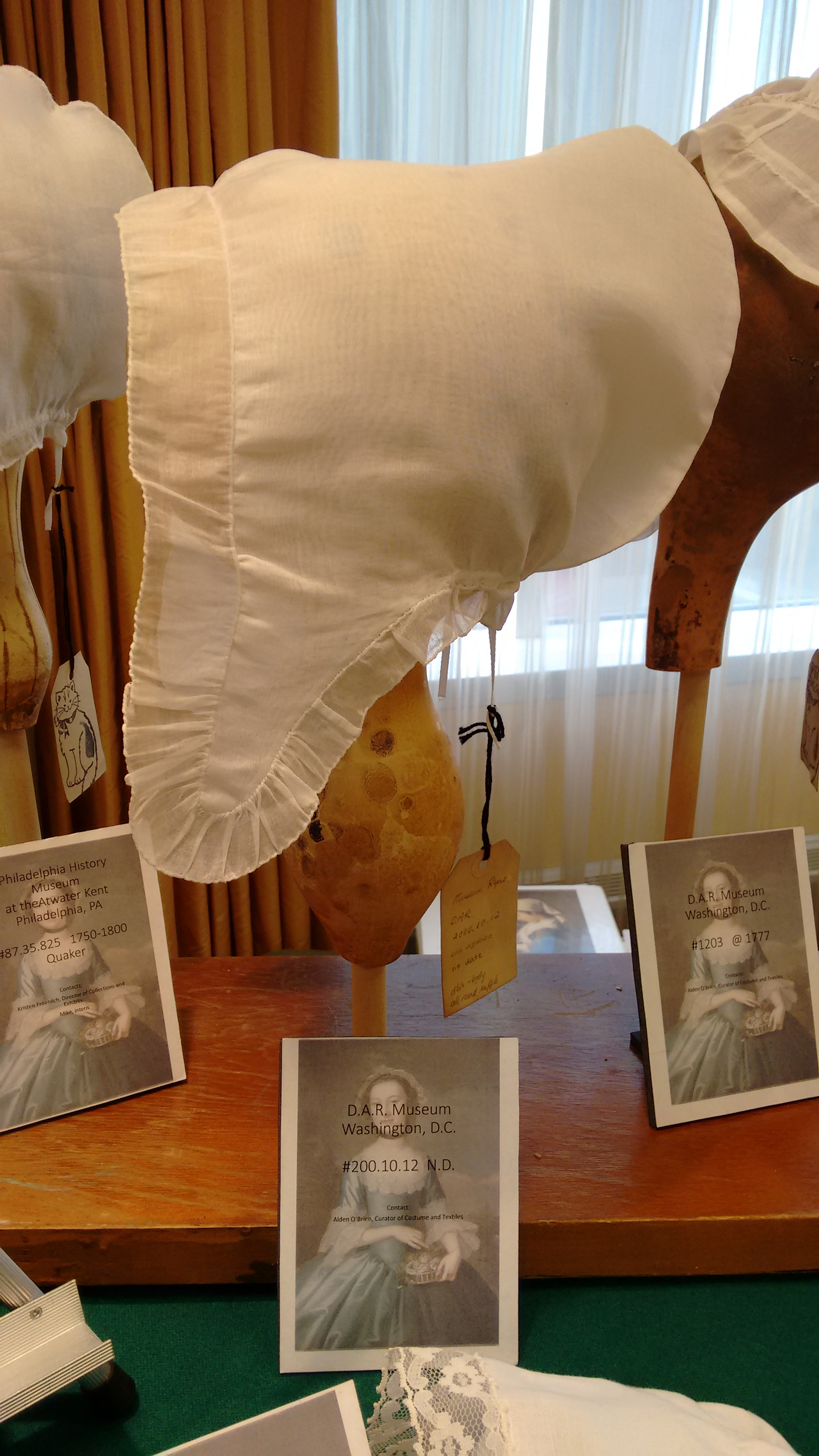
The Evidence: American Portraits


We have two main sources of evidence for anything we say about caps in the 18th C.  -portraits and artifacts. *  This article is about the portrait evidence.

Narrow the set of portraits to only those that are American, adult, 18th C, and women**.  Throw out English, European and children, and see what is left. The results are surprising.

These ideas are based on a set of about 300 portraits gathered from books, internet searches, and museums visits, over a 15-year period.  I feel I can make these generalizations because, even as I add more portraits to the set, the ratios aren’t changing.

(This is an actual research method, where you gather data without making hypotheses, and stop gathering when you seem to be getting mostly repeats in the same ratios.  I was glad to learn this recently.)

Here’s what I found:

  1. We have no cap evidence before 1750.  American portraits are rare in the first half of the century. Of the few we have, most wore no cap for their portrait. 
  2. The majority of women across the 18th C wear no cap in their portrait.  There are feathers and flowers, pearls and ribbons in their hair.  Around 1765-1789, there is a vogue for veils in portraits called A la Turque. After 1785, younger women in Empire styles wore fewer caps in general than their elders.
  3. There are no genre paintings made in America until 1796.  These portraits are of women with money.
  4. Between 1750 and 1775, women wore one of two caps: one with a ruffle under the chin, and one without.  These are commonly called a “lappet cap” (ruffle under the chin) and a “round-eared cap” (ruffles curve around near your ears). There are more lappets than round-eared caps (a little more than half), especially among older women in portraits. (In artifacts, lappets far outnumber the 2 round-eared caps I discovered.) 
  5. After 1775, the cap world explodes with mushrooms and clouds of caps, piles of linen and lace, chef’s caps, bonnet-like styles, the Dormeuse, and the Corday. . .
  6. … until caps disappear from young and fashionable heads with the emergence of Empire styles in the late 1780’s.
  7. Meanwhile, older women continued to wear the lappets they had always worn.
  8. And Quakers wear an especially plain – and fine – version of the lappet that then becomes the fossilized style they wear for the next 100+ years.
     
  9. American cap styles are more sedate than many seen in portraits from Europe and Britain. We have only one portrait of a woman wearing really long lappets, lace or no lace, so common in French paintings. Another “missing” style is the scarf tied under the chin. Although these appear on poor women in Cries of Dublin, for ex., we do not find them in U.S. portraits or artifacts, perhaps only because we have no drawings of poor American women. Apart from Kilburn’s young woman, the dramatic butterfly cap is not apparent, although common in European portraits. Nor are there any ship – shaped hairdos with flags and feathers. Cap styles in the U.S. were, in general, more sedate.


I am not saying these women didn’t see the fashion plates, genre scenes, or portraits from England and Europe in a timely manner. We know they did.  They were aware of French hairdos and Swedish ruffle boxes. But portraits of rich women offer no evidence they actually wore them.  And that was the question I was asking.  


**By “American” I mean the areas of the North American colonies that became the United States.  While this short hand is inaccurate for all you geography sticklers, it is necessary for brevity.

By “women” I mean adults and not children, or even teenagers, where we can tell.

By “18th C” I mean 1700-1800.

*Other sources are newspaper ads from milliners and makers, a handful of first-person mentions, court records, death inventories.  Here’s a wide-open field of research to plumb, digging into the ephemera. So far, I haven’t seen anything that describes the style of the cap.  But maybe you can find that to add to our understanding.

Final

What Cap Should I Wear? What the Rev War Camp-follower had on her head

I began this incredible odyssey many years ago with the question, “I am a camp-follower in the American War of Independence; which cap should I be wearing?”

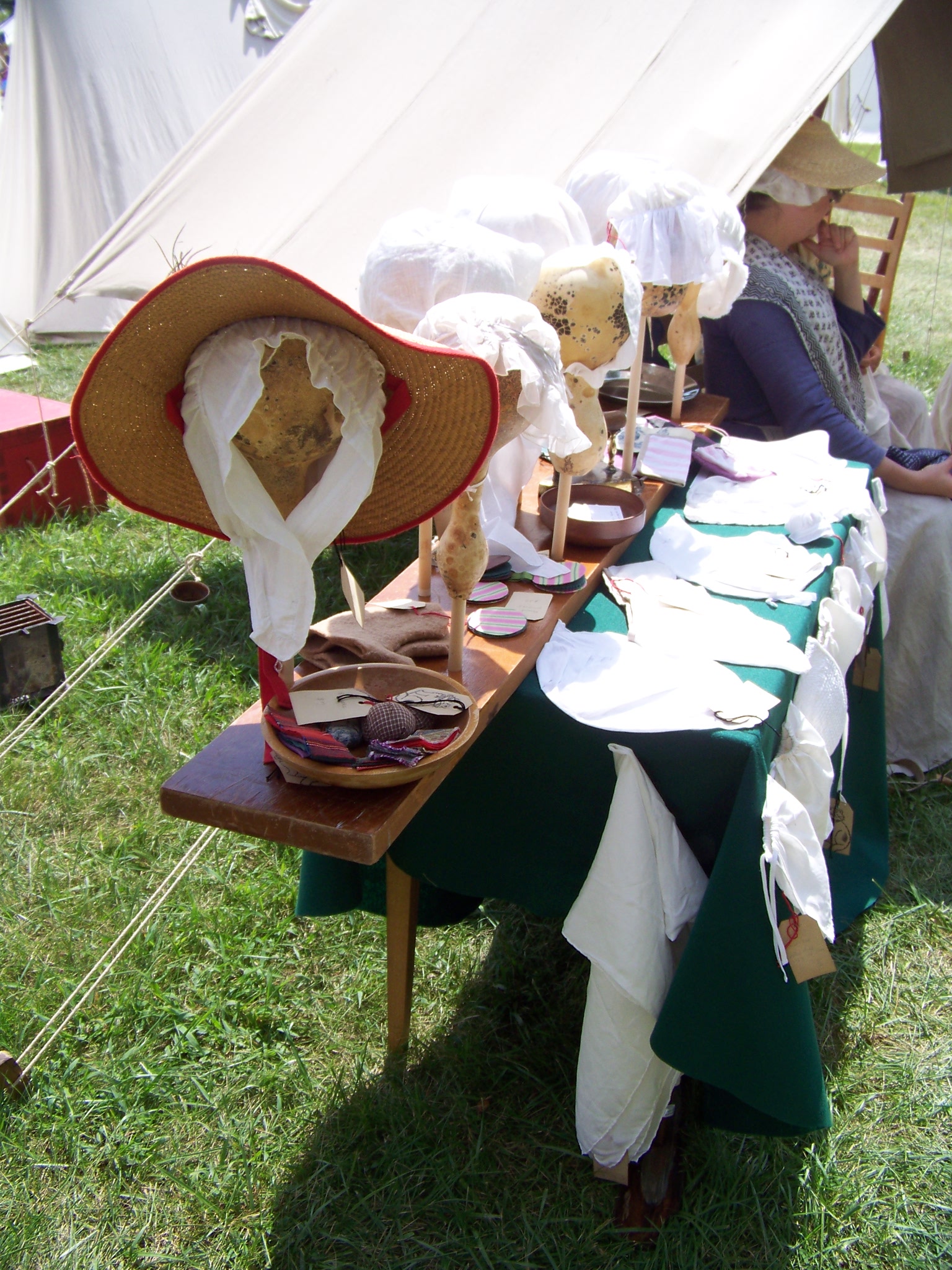
Table with caps on display in the sun.
My table full of caps, at the Fair at New Boston

Saines wearing 18th C clothing, with caps on display.
This is me at the Costume Society of American Symposium in 2016. I didn’t realize I was so completely grey!

So, here’s the easy answer: You can choose between 2 caps: one with a ruffle under the chin, and one without.  These are commonly called a “lappet cap” (ruffle under the chin) and a “round-eared cap” (ruffles curve around near your ears).

See the Glossary for more definitions.

I base this answer on a sample set of about 300 portraits of American women, and the more than 100 caps I have examined in museum collections in America.  I am chronicling this research over time with this blog, so you can see what I am seeing.

I’m also basing this on an assumption that camp-followers would not be seeking the latest styles because their circumstances demanded practicality and frugality.  Assumptions are dangerous things, of course, and no one that I know of recorded that sentiment directly, but it is supported by what we know of their difficult lives, documented in many sources.

Note: I would, however, fully expect visiting officer’s wive  to wear the fashionable piles of linen and lace that arose around 1775 and grew larger over time.  (More on that over here…)

American cap styles are more restrained in general than French styles, of course (oh, those French!), but they are also more restrained than even English styles.

What should my cap be made of? 

The finest linen you can afford. Because linen of the era tended to be finer than ours, our lightest handkerchief linen (2.0- 3.0 ozs) is a good match.  And, of course, the richer your persona, the finer the cloth should be.

Does it have to be white?

Yes. Every artifact is plain white. There are a few examples of colored caps or cap covers in European paintings, and a few examples of a black kerch over a white cap in America. I am aware of only one American cap that is made of patterned cloth.

Do I have to sew this by hand?

Yes, you have no choice because HA caps cannot be made on a machine. There are no hidden stitches.

Should I make the ruffle out of lace?

Only if you are an officer’s wife.  Lace was so very expensive, camp-followers shouldn’t include it on their caps.  What you can do, though, is make the linen ruffle from an even lighter linen than the rest of the cap.  This is common enough.  And, just like our WAI predecessors, maybe you can afford just 1/4 yard of that exquisite stuff to add to your cap.

Should I wear a ribbon?

YES! We should all be wearing a plain silk ribbon tied in a bow over the headpiece.  These can be pinned on so washing is easy. Depictions of even the meanest women of our era include a ribbon around her cap.

Can I piece it together from scraps?

Yes. I’ve seen caps pieced in all different places: the top of the headpiece and along the ruffle is common, but one cap has 3 pieces just in the caul.

Can I re-purpose used linen?

I say yes to used linen because we shouldn’t be as clean or tidy or new looking as we usually are.  Also, linen shirts from the second hand store are a really good source of finer linen than we can get easily by the yard.

1750 portrait of Mrs. Pemberton by Wollaston. © Museum of Art, Rhode Island School of Design, Providence
Nice example of lappet cap with lace ruffles. Portrait of Mrs. Ebenezer Pemberton 1750 John Wollaston, American, fl. 1733-1775 Artstor IAP

I hate having something under my chin! 

I know, honey, but you got used to stays, didn’t you? Lappets are a little more common than round-eared caps, and are underrepresented in reenacting, I think. So, yes, make yourself a lappet. And you can leave your lappets lose; there are a few examples showing them worn that way, but it is not the norm. (And only the French pinned them up.) 

Where can I get an HA pattern?  

I keep going around on this question…

I’ve bought and tried just about every pattern out there. The most common problem is the caul is just too big (and I have a large head). Another common problem is directions adapting caps for machine sewing and muslin cloth. Ouch.

I’m still saying Kannik’s Korner 6602 is the closest for the round-eared cap. It also includes really good directions and documentation.  But her sources are a smidge later than AWI.  I recommend starting here, but making the small size caul.. . . .

Also, the split ruffle is, of course, characteristic of the fancy caps, so save that for your not-a-camp-follower outfit. I’m actually having second thoughts even about the shape of the ruffle on this pattern, as all the ruffles I’ve seen on cap artifacts are straight strips. And, you’d want to make the headpiece straight, not curved.

For a lappet, you could start with Instructions for Cutting Out Apparel for the Poor, which isn’t the most common 3-piece construction, but is at least verifiably accurate, really easy to make, and free on Google. Still, it’s 1789, but I have seen one dated earlier.

Rural Pennsylvania Clothing has a lappet that’s pretty close, but the headpiece is too wide, and there’s a button on the tips, so definitely later.  Someone made commercial patterns of the caps in that book, but you can just use it straight from the source.

….I see a need for patterns that copy common construction for our era…  well, that’s a project for another day….   WAIT, I DID THAT! I made a lappet pattern that is an average of all the lappets I saw.  Enjoy.

This image has an empty alt attribute; its file name is img_20210110_224752337.jpg

I didn’t make a round-eared cap pattern because so far we only have 2 that are probably 18th C, and both are very late.  So there’s not enough evidence here to find an average so to speak, and the 2 examples are too late anyway.  I could create a pattern that looks like what we see in portraits, but that’d be cheating because it wouldn’t be based on artifacts.

Here are some things we do not see in the American portrait evidence for 1750-1775:

  1. Caps that cover the face, or ruffles long enough to fall down the chin or into the eyes.  Reenactors frequently wear too big a cap, pulled too far forward.
  2. That very old BAR pattern that has a paddle-shaped, double-layered headpiece. I’m still trying to figure out where that came from.  If an original exists for it, it is a rarity and should not be used.
  3. A lot more round-eared than lappet caps. In both the portrait evidence and the artifact evidence, lappets outnumber round-eared caps. My current count is 21 lappets to 2 round-eared caps among artifacts, and about 50 lappets to 48 round-eared caps in the original portrait set.
  4. No tightly gathered ruffles down the front of the lappet.  The ruffle of a lappet is gathered only at the turn around the tips.
  5. No “butterflies”.  These are the caps with stiffly starched wings riding high on the head. One portrait of an American child has this. No adults.
  6. No ships, no birds, no turkey butts, no 3 foot hairdos, nothing from Versailles.  No evidence of this craziness exists for American women in portraits or artifacts.
  7. Gehret’s Rural Pennsylvania Clothing has a cap with a simple rectangular headpiece on a gathered caul, with strings under the chin, on Pg. 68.  This cap is only seen early and late in the century, and not during our time period.  Too bad! I made a bunch of these!

version #5. Still needs portraits

Double Caul: DAR 2000.10.2 Lappet

Here (DAR 2000.10.2) is a good example of common 18th C lappet cap construction . . . or at least it seems so until you take a closer look.

The Artifact

Here are 2 photos I made of the cap at the Daughters of the American Revolution Museum in Washington, D.C.

I had already seen many caps and if you had asked, I would have said, “The caul is never doubled.”  And then, bang! here’s a double caul.  It’s still the only one I’ve seen, but it just shows to go you can never say never.

This cap is made of a very light weight, sheer cloth, probably linen. The overlap of the two layers on the caul vs. the single layer of the ruffle makes the ruffles look very delicate.  There are only 2 pieces here:  the caul, which includes the extended lappets, and the ruffle, which encircles the entire edge.  The ruffle is gathered only at the turns of the points.  A skinny tape gathers the nape, tied at the inside center back, and two 5-inch pieces are sewn on the lappet ends to tie under the chin.

The ruffles are whipped all around 1/32″ with a stitches so tiny I really couldn’t even find them.  Then the ruffle is whipped to the edges of the caul, completely encircling the cap. The ruffle is 1 1/4″ at the center front point, but skinnys down to 3/4″ by the time it rounds the tip and meets at the nape of the neck.  I’ve seen that in a lot of caps, that the ruffle narrows after the tip.  I don’t know why.

Here’s my reproduction

It was a real puzzle to figure out how to cut out a double caul with only one felled seam up the back.  I tried many twisty variations before I understood that you cut the shape with the folds across the top of the head AND down the whole front from the center top to the end of lappet.  Now, sew all 4 layers of cloth together up the back, and finally, unfold one layer to enclose the stitches.  Now you can fold the other unfinished edges under 1/8″and  hem them.

Lappet cap with complex doubled caul.
My repro of this cap: the back looks like a tunnel because I curved the piece in too much.

I rounded the shape at the nape, and I think that isn’t right. It creates that funnel effect that isn’t on the original. Also, I always have trouble getting that gather around the tip just right so it neither stretches the cloth nor comes out too bunchy.  I can also see my stitches on the outside edge of the ruffle are not nearly fine enough.

Notes and Pattern

Here  are my notes and the pattern I created. My notes are very note-like: messy and a little confusing, but I keep coming back to these with more questions, and I figure you might, too.

Click here for notes and pattern: DAR 2000.10.2 notes

Questions 

The doubled caul makes me wonder in awe at the ingenuity of this maker.  She had a lot of this fine linen and must have thought it was too thin for her purposes.  How did she invent that sew and flip thing?  Here I’m going on my own idea that women weren’t passing around patterns, but based on a general understanding of how caps are made, invented their own ways to create the effect they desired.  

Thank Yous

Thanks to Alden O’Brien, Curator of Costumes and Textiles, of the Daughters of the American Revolution Museum in Washington, DC, who gave me permission to blog about the DAR caps I saw.

Other Research

This cap is not in their online catalog. It has no provenance or date. Ms. O’Brien suggested I look at this one as it shares characteristics of other 18th C caps, in her experience.

Portraits

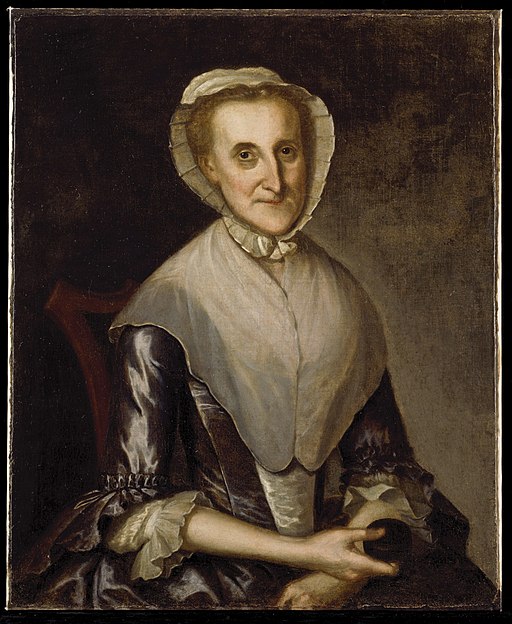
Women with a lappet cap aren’t hard to find.  A little less common is this ruffle that goes all the way around the cap, making a complete circle once it is gathered at the nape of the neck.  That means your neck is encircled by the ruffle, giving it almost the effect of a linen choker necklace.  


Woman in dark purple dress, large white neck kerchief and simple lappet cap, holding a small round box.
Ann Fitzhugh Rose, 1771, Virginia. Ann’s cap is a simple lappet like this one, with a ruffle that goes all the way around, tied under the chin. We cannot determine if this caul is doubled, of course! Williamsburg.

Final.