Pieced Caul: Genesee 91.170.1

A uniquely pieced caul , and a unique method of felling seams, make this cap interesting.  It’s a lace-edged lappet, made of soft linen. The museum dates it 1750.

Genesee Country Village and Museum owns this cap. Genesee is a living history setting; its John L Wehle Gallery museum houses the Susan Greene Costume Collection. If you are interested in learning about caps, the Greene catalog is the place to start. Sadly, I got to Genesee at the end of my travels, having spent several years re-discovering much of the info she had already cataloged.  The marvelous catalog describes each item, and the caps are dated! If I had an endowment to offer, I would make sure this catalog was open to the public web.  I went there in search of the caps Kathleen Kannik references in her pattern KK-602. Those caps were dated 1815, but gallery curator Patricia Tice suggested I look at this cap and Genesee 86.213.  Bingo!

The Original

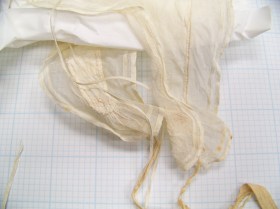
Lappet cap with tape measure showing the height to be about 12 inches.
Genesee 91.170.1 is a typical lappet, but the piecing of the caul is unusual.

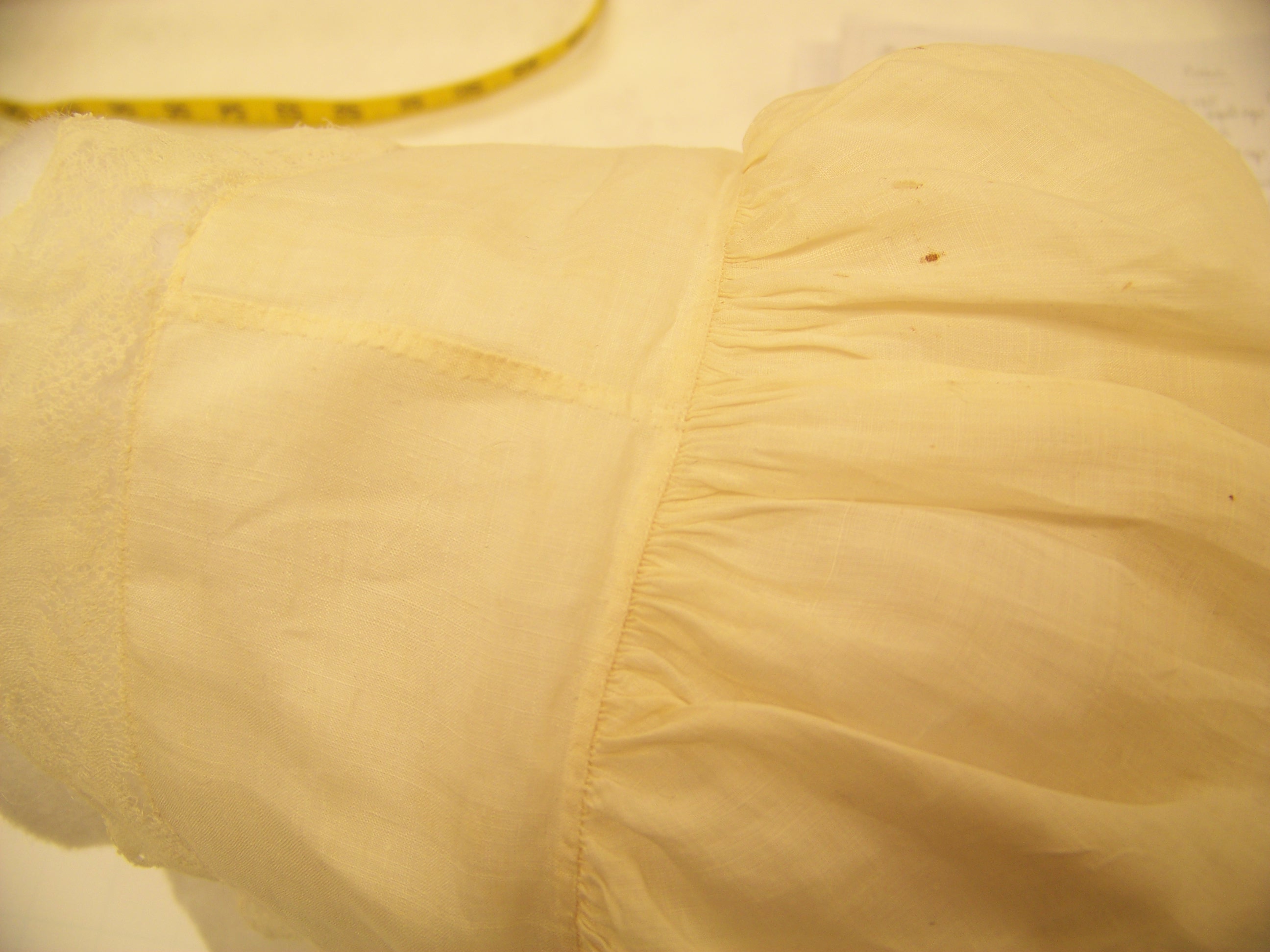
Several construction details make this cap interesting and unique.  First is the pieced caul.  It’s made of a rectangle in the middle, a pointed rectangle on the bottom, and curved and gathered piece on top.  The bottom has a 1/4″ channel for the gather strings, which come out of 2 buttonholed circles on the outside CB.

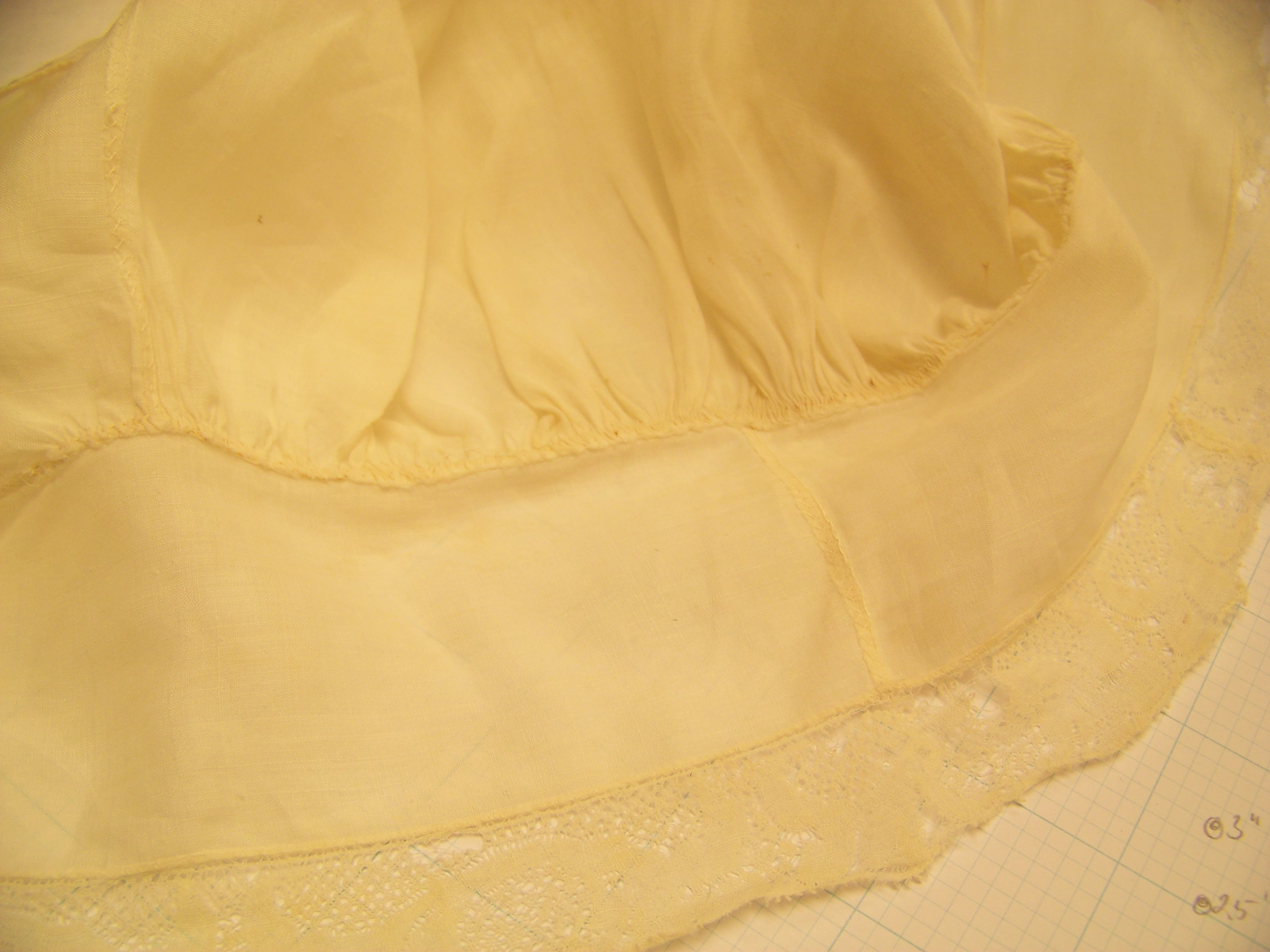
Each piece is sewn together, and then felled with a criss-cross stitch inside, about 12 Xs to the inch.  I’d never seen that done, but it makes a neat finish, and lays down both sides of the folded seam at the same time.  Clever.

Those criss-cross felled seams are used on the join at the top of the headpiece, too.  The headpiece is stroke gathered to the caul, but after the gather, the caul is joined to the headpiece with the same kind of XX stitch.

The lappet is also pieced…. I’m beginning to see a pattern here….  the bottom 2″ ends are sewn with a straight stitch and left unfinished.
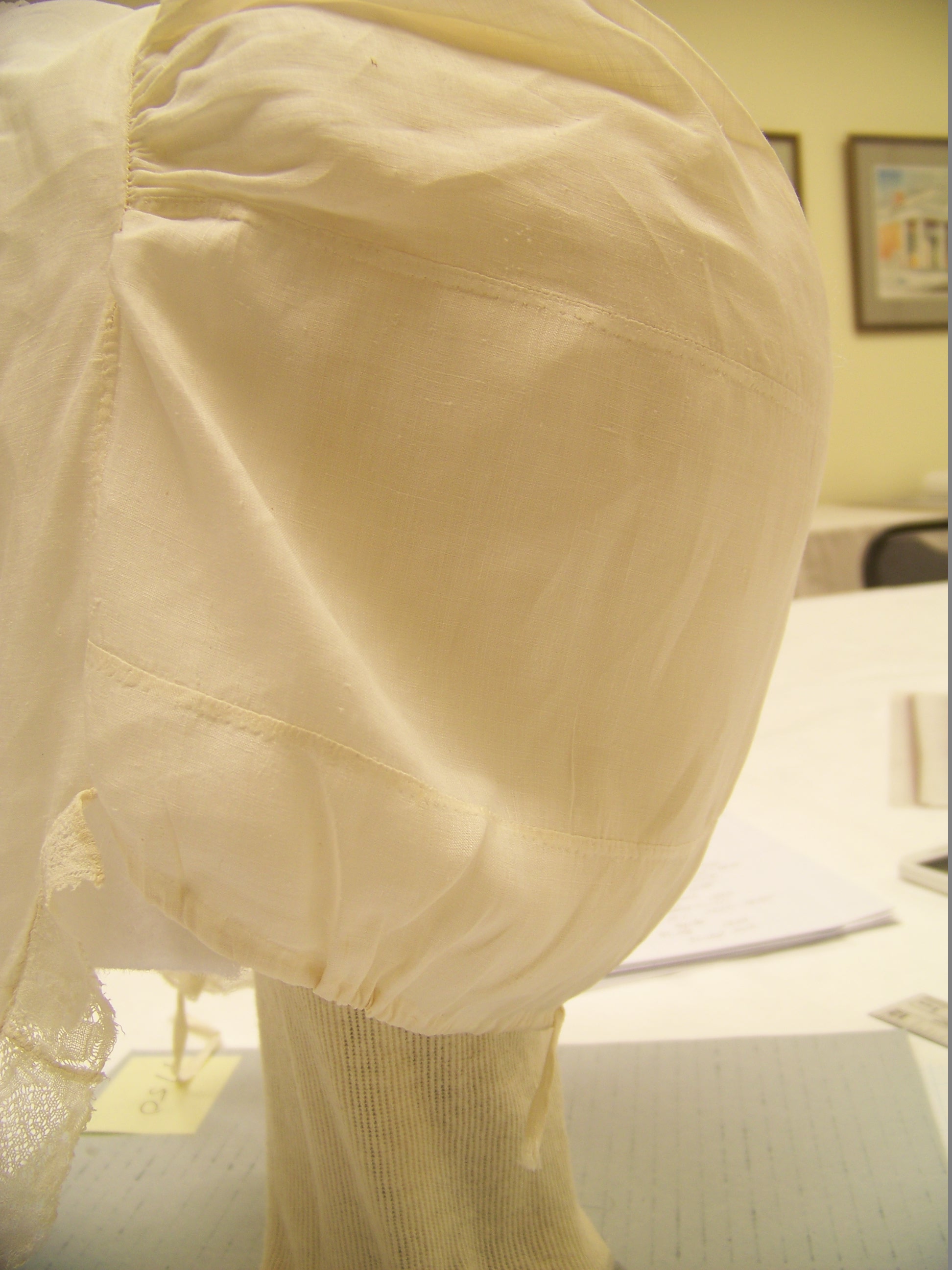
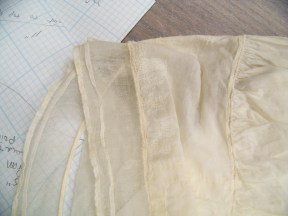
Linen cap, detail of back.
You can see the three pieces of the caul here.

The lappets are edged in 1″ lace (also pieced!), which the catalog says is CA 1700 Valenciennes Lace.  As I am not a lace researcher, (next life!) I accept her designation.  It is only slightly gathered, with enough bunching to get around the tip.  Short 3/8″ tapes are sewn on the underside, then threaded out through the lace, emerging on the outside point to be tied.  That means the lace would be under the bow when worn.
Questions that remain

The fact that everything here is pieced is intriguing.  (By now I am imagining a grandmother desperate to work up a cap with her granddaughter, “Here, Honey, I think I have enough left over…”  Which also explains why the cap shows no signs of wear?)

Portraits

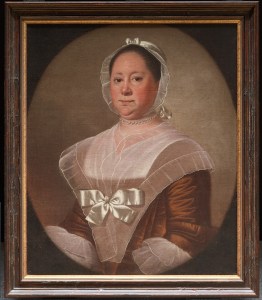
1749-52 John Wollaston, Catherine Harris Smith (Mrs. Ebenezer Pemberton) (Artstor IAP)
Yes, I can use this portrait again and again.  Her bow appears to be silk, whereas this cap is tied with 3/8″ tapes.  1749-52 John Wollaston, Catherine Harris Smith (Mrs. Ebenezer Pemberton) (Artstor IAP)

The lace-edged lappet is a common mid-century cap.  One set of examples is John Wollaston’s gallery. It was either a big fashion during his painting years, or he had those 2 caps in his studio to choose from.  Gen 91.170.1 doesn’t have the extra bunch at the CF, like many of these portraits do, however.

The Reproduction

I had to remake pieces of this cap several times before I got it.  First the lappets were too fat, then they were too thin.  I put the holes for the gather strings on the inside, not the outside.  I was entirely finished When I discovered I put the bottom piece of the caul on upside down. I started over, and cut the same piece with the fold on the wrong side.  Egad.  I did finally got a satisfactory version accomplished — only to discover I once again put the holes for the gather strings on the wrong side.  So don’t look but this has 2 sets of holes.
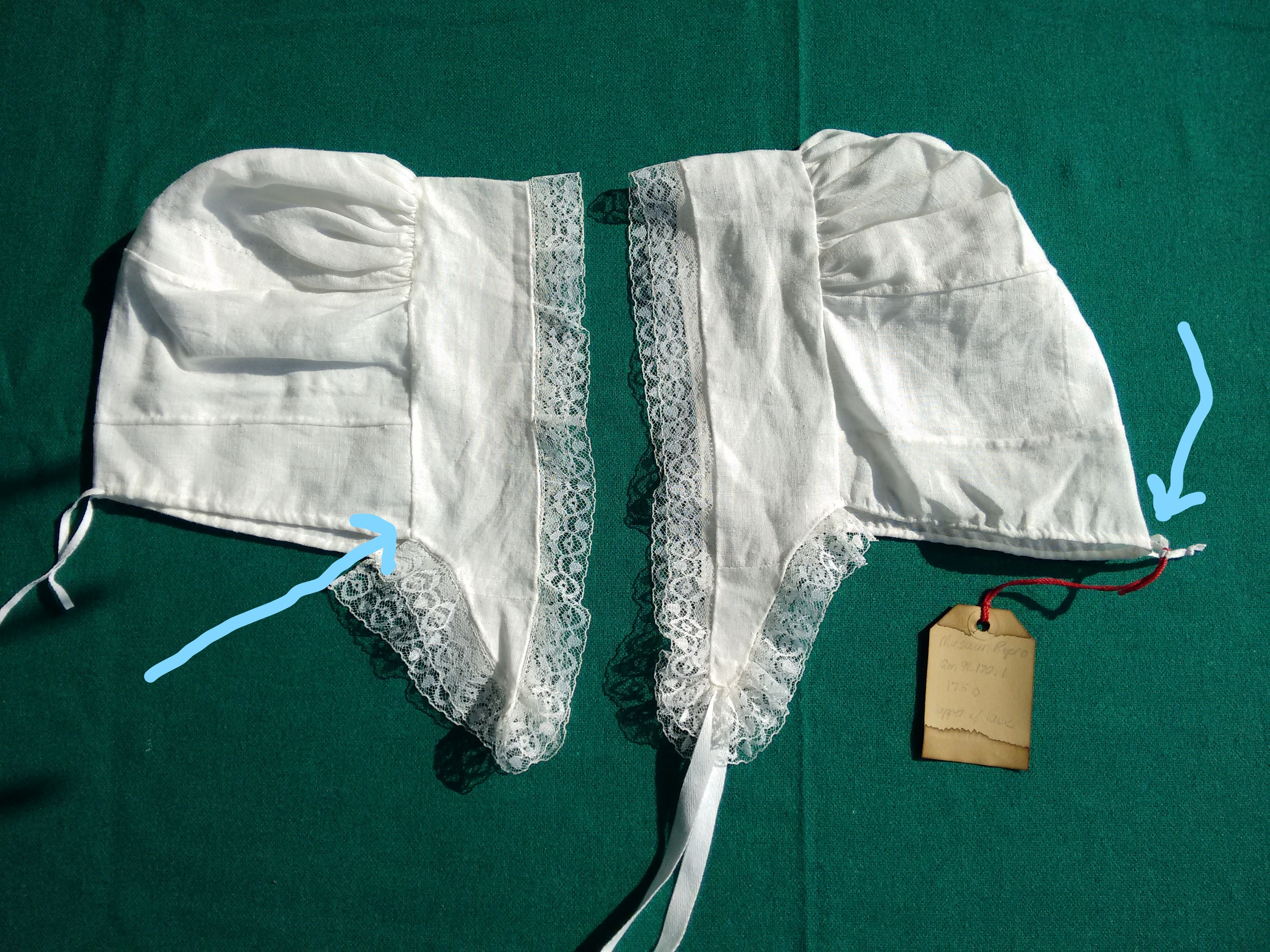
Two caps, attempts at the same repro.
On the left, the first try; on the right, the corrected version.

My Notes

Click here for notes and pattern: gen 91.170.1

Thank Yous and Permissions

This cap is presented here with permission, Courtesy Susan Greene Costume Collection, Genesee Country Village & Museum, Mumford, NY.  I worked with Patricia Tice on my visit to Genesee.   I also corresponded with Susan Green, who generously helped me understand what I was seeing here.

Photos by the author.

Other Related Scholarship

This cap does not have an online catalog record. I am not aware of any other scholarship about this cap.

Final.

Kissing Strings: New Canaan CE419

“Kissing strings” are long (40″ on this one) tapes that extend forward from the nape gather. I keep asking what people think the use was, and here are a few of the ideas:

  • wrap them back up over your head to help secure cap
  • some illogical fashion trend; some marker of age
  • made that way with the intention of cutting them shorter as per user’s head size
  • someone else can grab them and pull the wearer close — to kiss!

I haven’t seen any visible in portraits, so we’re guessing here.

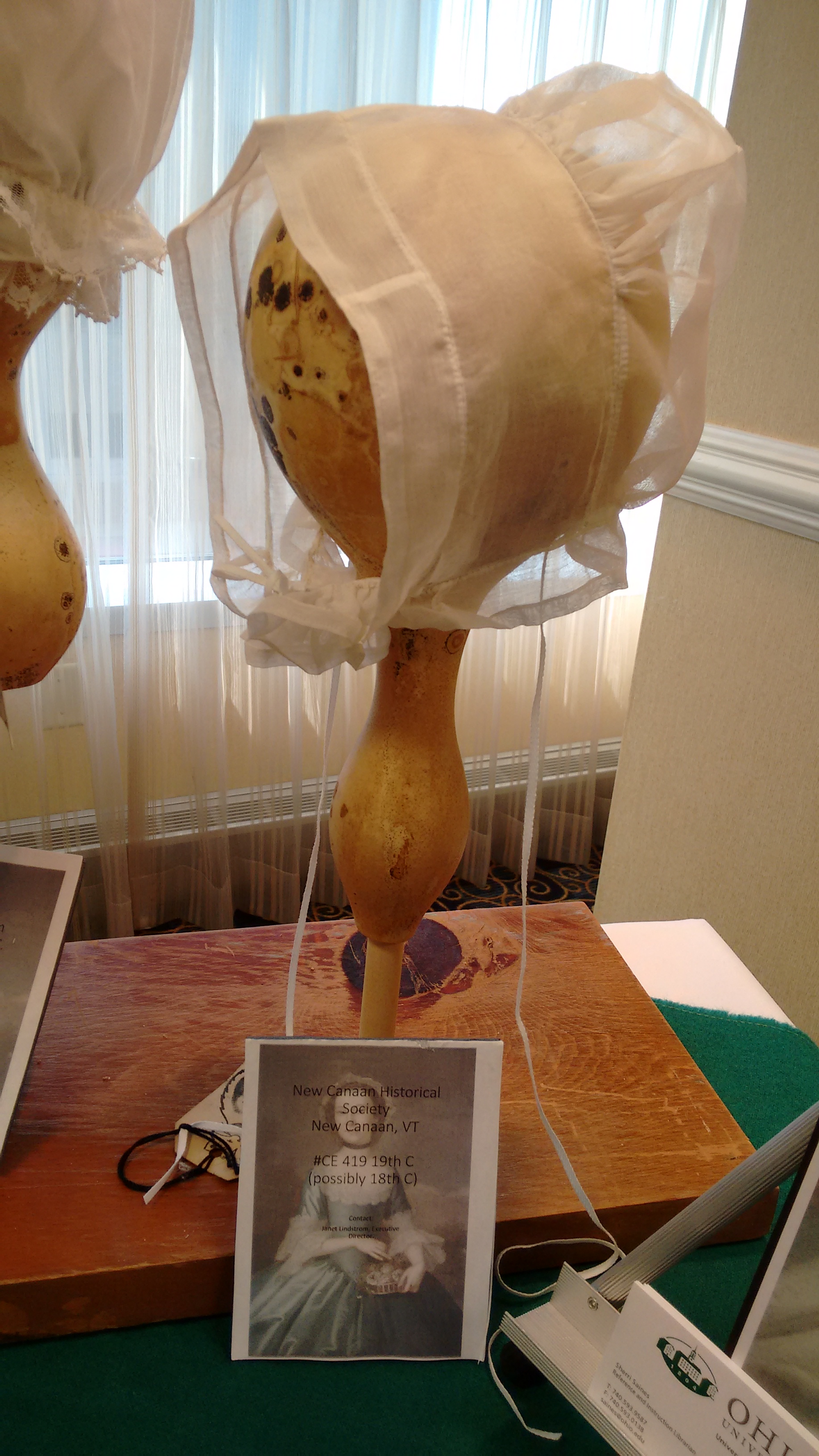
This cap, from the New Canaan Historical Society in New Canaan,  Connecticut, collection, is a good example.

The Original

Lappet with many 18th C characteristics.
New Canaan Historical Society CE 419

I argue for an 18th C date because of its common 3-piece construction: caul, headpiece, ruffle. And because it doesn’t have  the characteristics of a 19th C cap.  It has one little 1/16″ pintuck 1/4″ in from the edge all down the front edge of the ruffle. Oh, and ribbons that tie the lappets. I wondered how those were done. In the portrait section, see examples of both.

The cloth is fine, probably linen, and the ruffle is even finer.  Many many mended areas on the headpiece tell us it was well loved & used.

The stitches are tiny, fine, even. Along the front ruffle edge, a 1/8″ hem finish; go in 1/4″, and there’s a 1/8″ pintuck. The ruffle is joined to headpiece with 2 1/16″ hems butted together.  The caul joined to the (hemmed) headpiece with a whipped gather. I count 25 or more of those popcorn stitches to the inch.

The lappets are 3.5″ long, and a 6″ long, 1/4″  ribbon (now shredded), handmade from a piece of silk, ties the ends.

The group of caps in their collection were donated by Deborah Bead. We corresponded briefly, and she said she did her best to date the caps, using reference sources like Cunnington’s Dictionary of Fashion History 

CF of cap showing ruffle and headpiece details.
The pintuck on the ruffle, and many mendings are visible here. Get a close look at those whipped gathers on the CF of the caul. New Canaan CE419
Lappet cap ends with strings.
Gathers at the ends of the lappets are fine, just enough to get around the turn. You can see the ruffles are finer than the headpiece.
Tattered ribbons still hanging on.
The ribbon ties are in bad shape. New Canaan CE 419

Questions that remain

Mended areas are always interesting, and this cap has a lot.  One possibility is some conservator did them, of course; the other is someone who loved this cap wanted to keep using it.  Did people wear mended caps?  I can see fixing a little hole or tear, but this is a lot of visible mending. Does that mean the owner was poor?  So much we can’t know.

Portraits

The difference here is lace ruffles are gathered more than the artifact we are seeing.
She has ribbon ties on her lappets! Creator: John Wollaston, American, fl. 1733-1775; Title: Portrait of Mrs. Ebenezer Pemberton. Artstor IAP

Mrs. Pemberton wears a cap with ribbon ties.  Her ruffles are gathered all the way down the lappets, whereas on CE419, the only gather is at the tip of the lappet, to get around the curve.

More like…  Mary Trussler, 1760.

portrait of Mrs. Trusler in brown dress with large bow, and simple lappet.
Mary Trussler’s cap has very little gathering down the front of the ruffle.

Her cap is almost straight down the sides, like this one. Her ruffle appears to have a little pintuck in it.  18th C portraits can have such incredible detail in them.  The painting of transparent cloth is such a wonder to me

The Reproduction

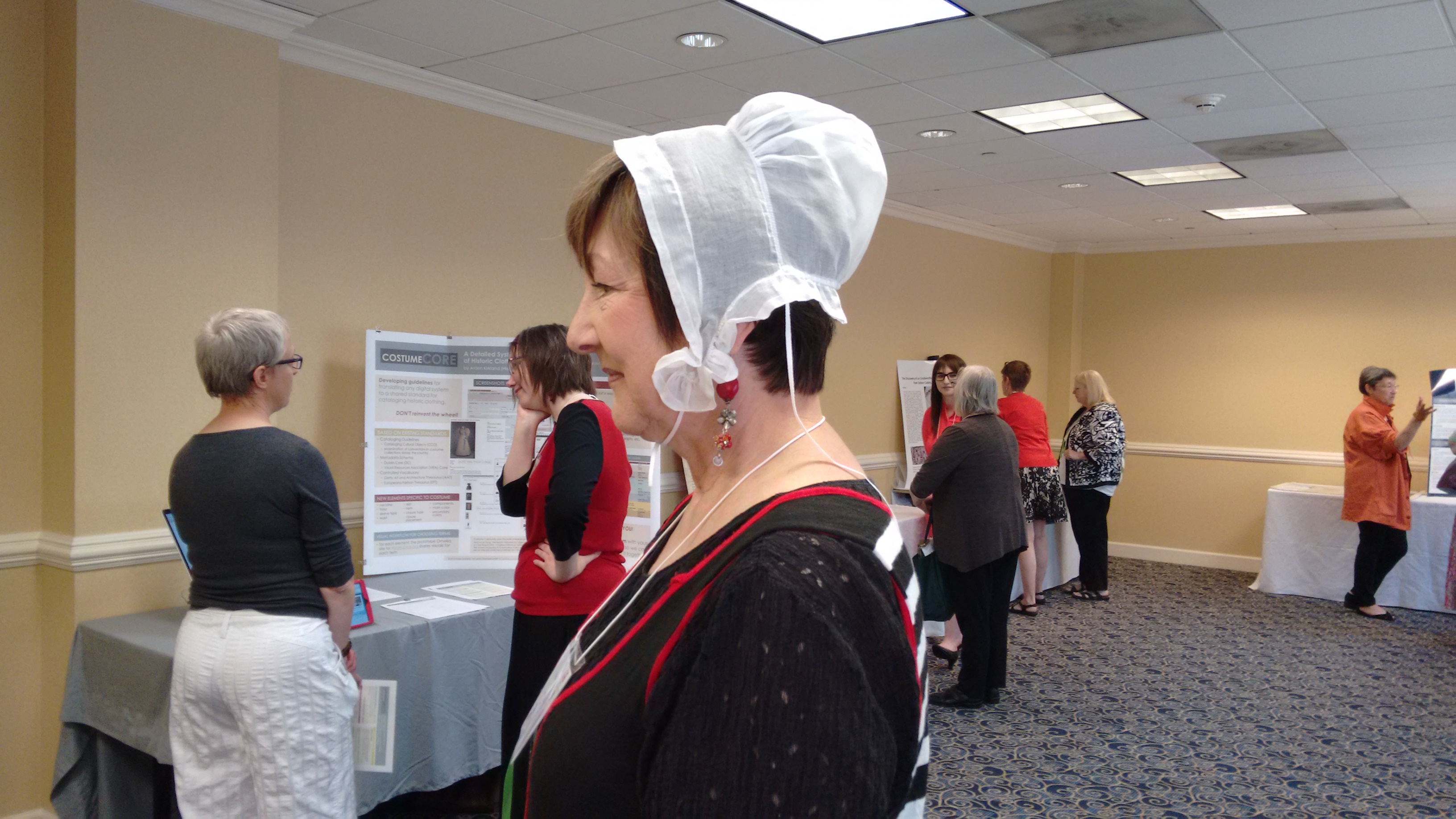
CE 419 modeled, shows how small this cap is.
A member of the Costume Society of America tried on New Canaan CE 419 for size at my exhibit there in 2016.
Saines' repro of this cap on a stand.
Once tucked under the chin, you can see how the over-gathering of the ruffle at the point creates a problem.

I think this was the first time I tried to do gathers around a lappet, and my effort is pretty comical.  No, there aren’t supposed to be those little puffs at her cheek.

Mimicking the tiny tiny stitches made this a fun challenge.  I used cotton organdy to mimic the fineness of the original cloth, and cotton mull for the ruffle.

Making a reproduction gives us a chance to TRY ON a cap and see how it would sit on a real head.  It allows us to touch and question the original design.  The artifact is so delicate it could not even be mounted, but now, despite my learner’s mistakes, we can try out the strings and see if they work tied up.  (We thought it was possible, but not really practical.)

Notes and Pattern

Click here for notes and pattern: New Can CE 419 notes

Thank Yous and Permissions

Photos by the author.  Permission to use these photos granted by NCHS 2018, via Penny Havard, Curator of Textiles. Thanks to Janet Lindstrom, who was curator at the time of my visit. Thanks to my model from the CSA.

Other Related Scholarship

New Canaan does not have an online catalog of their items.

I am not aware of any other scholarship about this item.

Final.